Online football betting in India has exploded over the past few years, with thousands of new punters logging into betting sites daily to wager on the Indian Super League, Premier League, Champions League, and international matches. However, alongside this growth comes confusion about the sheer variety of betting markets available. Among the most misunderstood—yet incredibly useful—is Draw No Bet, often abbreviated as DNB.
If you’ve been browsing football betting markets on Indian sportsbooks and seen “Draw No Bet” listed alongside traditional win/loss options, you may have wondered what it means. In simple terms, Draw No Bet is a market where you back a team to win, but if the match ends in a draw, your stake is refunded rather than lost. Think of it as a form of insurance against one of football’s most common outcomes. For Indian football fans, this protection can be especially valuable when betting on tight matches, derby games, or teams known for defensive play—situations where a draw is statistically likely.
This guide walks you through exactly how Draw No Bet works, why bookmakers offer it, when it makes sense to use it, and how to maximize its value alongside other low-risk markets. Whether you’re new to online betting or a seasoned punter looking to refine your strategy, understanding DNB will give you more control over risk and help you make smarter decisions with your bankroll.
What Is Draw No Bet in Football Betting?
Draw No Bet is a two-outcome football betting market that eliminates the possibility of a loss due to a draw. When you place a Draw No Bet wager, you are backing one team to win the match. If that team wins, you receive your payout at the agreed odds. If the match ends in a draw, your stake is returned in full—no loss, no profit. If your chosen team loses, you lose your stake just as you would in any other bet.
The term “Draw No Bet” is sometimes called “Tie No Bet” in certain regions, and the concept is often referred to globally as a “push” in betting terminology. A push means the bet is voided and your stake is refunded. This removal of one outcome—the draw—is what makes DNB fundamentally different from the traditional three-way football betting market known as 1X2.
| Aspect | Draw No Bet (DNB) | Traditional 1X2 |
|---|---|---|
| Outcomes Available | Home win or Away win (draw refunded) | Home win, Draw, Away win |
| Stake if Draw | Refunded in full | Lost in full |
| Typical Odds Range | 1.60–2.20 (home), 1.80–2.50 (away) | 1.50–2.10 (home), 3.20–3.80 (draw), 3.50–5.00 (away) |
| Risk Level | Reduced (one outcome eliminated) | Higher (all three outcomes possible) |
| When to Use | High draw probability, defensive matches | When confident in outcome or willing to risk draw loss |
| Bookmaker Margin | Lower (fewer outcomes = less margin) | Higher (three outcomes create larger vigorish) |
Basic Mechanics: Win, Draw, and Loss Outcomes
Understanding exactly what happens in each scenario is crucial for using Draw No Bet effectively. Let’s break down the three possibilities:
- Team Wins: If your chosen team wins the match, you receive your stake multiplied by the odds. For example, if you bet ₹1,000 on a team at DNB odds of 1.85, and that team wins, you receive ₹1,850 (₹1,000 × 1.85), netting a profit of ₹850.
- Match Ends in a Draw: If the match finishes in a draw, your original stake of ₹1,000 is refunded to your account immediately. You have neither won nor lost. This is the “no bet” part—your money is returned untouched.
- Team Loses: If your chosen team loses, your stake is forfeited completely, just as it would be in a standard 1X2 moneyline bet. You receive nothing; the ₹1,000 is gone.
This structure is why many Indian bettors use DNB when they want to back a team they slightly favour but fear the financial damage of a draw.
Why Bookmakers Offer Draw No Bet
Bookmakers offer Draw No Bet markets because they serve a genuine demand and create operational advantages for sportsbooks. By removing one outcome, bookmakers simplify the decision-making process for casual punters, which increases betting volume and engagement. More bets placed means more revenue for the operator.
From an odds-setting perspective, DNB allows bookmakers to adjust their prices to reflect the lower risk. Since the draw outcome is eliminated, the implied probability of a win must increase. This means the odds for a home or away win will be shorter (lower) than they would be in a 1X2 market, reducing the bookmaker’s potential exposure and making it easier to balance their book. Football has a naturally high draw frequency—roughly 25% of professional matches end level—so DNB is especially popular for football betting compared to sports with fewer draws, like basketball or tennis.
Draw No Bet vs 1X2: How the Odds and Risk Change
Understanding the relationship between Draw No Bet and the traditional 1X2 market is essential for comparing value and deciding which market suits your betting strategy. The core difference is that DNB removes the draw as a possible outcome, while 1X2 includes it.
| Market Type | Available Outcomes | Risk Profile | Typical Odds | Result if Match Is Drawn? |
|---|---|---|---|---|
| Draw No Bet (Home) | Home win only (draw = refund) | Lower | 1.70–1.95 | Stake refunded |
| Draw No Bet (Away) | Away win only (draw = refund) | Lower | 2.10–2.60 | Stake refunded |
| 1X2 (Home Win) | Home win (draw and away loss possible) | Higher | 1.50–1.80 | Stake lost |
| 1X2 (Draw) | Draw (home and away wins possible) | Highest | 3.20–3.80 | Bet wins |
| 1X2 (Away Win) | Away win (draw and home loss possible) | Higher | 3.50–5.00 | Stake lost |
Consider a real ISL example: Suppose FC Goa plays Kerala Blasters in a tight match. The 1X2 odds might be Home Win 1.70, Draw 3.40, Away Win 4.50. The corresponding Draw No Bet odds would be around Home 1.95 and Away 2.80. Notice that the DNB odds are lower than the 1X2 home win odds (1.95 vs 1.70) because the home win is now more likely relative to all outcomes (since draw is removed). However, if you believe Goa will win but fear a draw, the DNB option at 1.95 might be more valuable than committing to the 1X2 home at 1.70, because in the draw scenario, you’re protected.
Understanding Why Draw No Bet Odds Are Lower
When bookmakers shorten odds for Draw No Bet compared to 1X2, they’re responding to economics: the bettor’s risk is reduced, so the potential return must also decrease. In a 1X2 market, the bookmaker balances three possible outcomes; if one outcome is removed and its probability is redistributed to the other two, the odds for those two must fall. Think of it this way: in a 1X2 market with a 50% home win probability, a 25% draw probability, and a 25% away win probability, the implied probability of a home win is 50%. But in a DNB market where the draw is removed, the home win’s implied probability becomes 66.7% (50% ÷ 75%), so the odds must shorten to reflect that higher probability. Lower odds mean lower payouts, which compensates the bookmaker for reduced risk.
How Draw No Bet Works on Indian Football Betting Sites
Using Draw No Bet on Indian sportsbooks is straightforward, though the exact interface varies slightly between platforms. Most major Indian-facing betting sites—whether mobile apps or desktop versions—follow a consistent workflow. Here’s a step-by-step guide:
- Log into your sportsbook account with your username and password. Most Indian punters use mobile apps, which are optimized for fast navigation and low data consumption.
- Navigate to the Football section by tapping or clicking the sports menu. Look for categories like “Football,” “Soccer,” or “Football Leagues.”
- Select your desired match from the upcoming fixtures. Common options include Indian Super League, Premier League, Champions League, and international competitions.
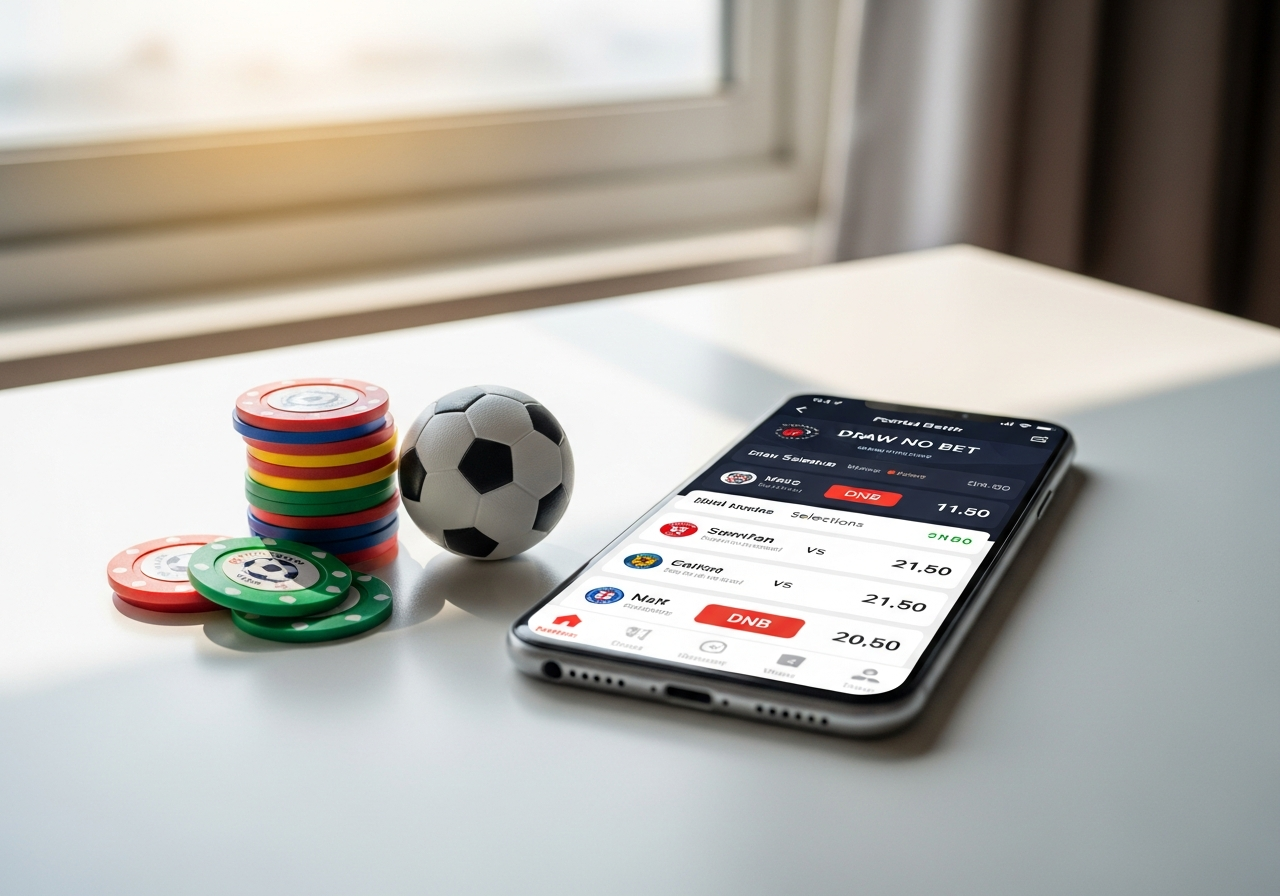
- Find the Draw No Bet market in the list of available betting options. It may be labeled “Draw No Bet,” “DNB,” “Tie No Bet,” or sometimes grouped under “Alternative Markets” or “Main Markets” depending on the sportsbook.
- Select your team (home or away) and enter your desired stake in rupees. The potential payout will update automatically.
- Review your bet slip, which shows the team, market, stake, odds, and potential profit.
- Confirm your bet by clicking the submit or “Place Bet” button. Your wager is now live.
Most Indian sportsbooks settle Draw No Bet markets based on the result at the end of 90 minutes plus official stoppage time. Extra time and penalties are typically not included in the DNB settlement unless the sportsbook’s terms specifically state otherwise. This is especially important in knockout cup competitions where extra time may be played.
Where to Find DNB in the Market Menu
On most Indian betting platforms, Draw No Bet is usually listed directly below the full-time result or 1X2 market. Many sportsbooks organize markets in order of popularity or perceived importance: 1X2 at the top, then DNB, then Asian handicaps, over/under, and other alternatives. Some sportsbooks feature a search or filter function that lets you type “Draw No Bet” to jump directly to it.
Mobile-first design is standard for Indian sportsbooks, so expect clean, scrollable lists of markets. If you can’t immediately spot DNB, look for an “All Markets” or “More Markets” link. On desktop versions, the market selection panel is usually on the left or centre of the screen, making it easy to browse and compare odds across different markets for the same match.
Settlement Rules: Regulation Time vs Extra Time
This is a critical detail that often causes confusion. Draw No Bet is almost always settled based on the score at the end of 90 minutes of play plus any official stoppage time added by the referee—usually 1 to 5 minutes. Extra time and penalty shootouts are not included in the standard DNB settlement.
Why does this matter? In knockout matches—such as Indian Super League playoffs, FA Cup, or Champions League knockout rounds—if a match is tied after 90 minutes, extra time is played. If the team you backed scores during extra time, you win at the higher of the regulation time or full-time odds, depending on the sportsbook’s rules. However, if the match is still tied after extra time and goes to penalties, the result at 90 minutes (a draw) applies, and your stake is refunded. Always check your sportsbook’s terms and conditions before placing a DNB bet on a knockout match, as some operators may have unique settlement rules or offer separate markets for “after extra time” outcomes.
Mathematics of Draw No Bet: Converting from 1X2 Odds
While most Indian bettors won’t need to manually calculate DNB odds, understanding the mathematics helps you spot value and, in rare cases, allows you to synthetically create a DNB position if your sportsbook hasn’t listed it explicitly. Bookmakers use the following approach to derive DNB odds from 1X2 markets:
The key concept is the removal of draw probability and its redistribution to the win outcomes. If you have 1X2 odds, you can convert them to implied probabilities, remove the draw, and then recalculate the DNB odds.
Worked Example: Creating Your Own Draw No Bet Position
Suppose a Premier League match has 1X2 odds of Home Win 1.80, Draw 3.50, Away Win 4.20. Here’s how you could manually create a Draw No Bet position by splitting a stake:
| Outcome | Stake (₹) | Odds | Result if Match Outcome Occurs |
|---|---|---|---|
| Home Win (1X2) | ₹667 | 1.80 | ₹1,200.60 |
| Draw (1X2) | ₹333 | 3.50 | ₹1,165.50 (stake refunded = ₹333 + ₹0 profit) |
| Away Win (1X2) | — | — | Home bet loses (₹667 lost) |
| Total Stake | ₹1,000 | — | If Home Wins: ₹1,200 (net +₹200); If Draw: ₹1,000 (net ₹0); If Away Wins: ₹0 (net −₹1,000) |
By staking ₹667 on home at 1.80 and ₹333 on draw at 3.50, you’ve created a synthetic DNB position: a home win pays ₹1,200.60, a draw returns your ₹1,000 stake, and a home loss results in a ₹1,000 loss. This mimics true DNB behaviour and allows you to approximate DNB odds even when the market isn’t explicitly offered. The effective DNB odds in this case would be approximately 1.50 (₹1,200 ÷ ₹1,000), which accounts for the stake refund on a draw.
Practical Examples for Indian Football Fans
To solidify your understanding, let’s walk through three realistic scenarios: an ISL match, a Premier League match frequently bet on by Indian fans, and an international competition.
| Match Example | Market Type | Stake (₹) | Final Score | Payout / Refund |
|---|---|---|---|---|
| ISL: FC Goa vs Bengaluru FC | 1X2 Home Win (1.75) | 1,000 | 2–1 (Goa wins) | ₹1,750 (profit ₹750) |
| ISL: FC Goa vs Bengaluru FC | DNB Home (1.95) | 1,000 | 2–1 (Goa wins) | ₹1,950 (profit ₹950) |
| ISL: FC Goa vs Bengaluru FC | 1X2 Home Win (1.75) | 1,000 | 1–1 (Draw) | ₹0 (loss ₹1,000) |
| ISL: FC Goa vs Bengaluru FC | DNB Home (1.95) | 1,000 | 1–1 (Draw) | ₹1,000 (stake refunded, net ₹0) |
| Premier League: Manchester United vs Liverpool | 1X2 Home Win (1.60) | 2,000 | 1–0 (United wins) | ₹3,200 (profit ₹1,200) |
| Premier League: Manchester United vs Liverpool | DNB Home (1.85) | 2,000 | 1–0 (United wins) | ₹3,700 (profit ₹1,700) |
| Premier League: Manchester United vs Liverpool | DNB Home (1.85) | 2,000 | 0–0 (Draw) | ₹2,000 (stake refunded, net ₹0) |
| Champions League: Barcelona vs AC Milan | DNB Away (2.40) | 1,500 | 1–2 (Milan wins) | ₹3,600 (profit ₹2,100) |
| Champions League: Barcelona vs AC Milan | DNB Away (2.40) | 1,500 | 2–2 (Draw) | ₹1,500 (stake refunded, net ₹0) |
ISL-Focused Draw No Bet Scenario
Consider FC Goa versus Bengaluru FC in the Indian Super League, a historically tight fixture. Goa is slightly favoured, and the 1X2 odds are Home 1.75, Draw 3.40, Away 4.10. The DNB odds are Home 1.95, Away 2.25. You believe Goa will likely win but recognize Bengaluru’s defensive strength and the statistical likelihood of a cagey 0–0 or 1–1 draw.
You decide to stake ₹1,000 on Goa DNB at 1.95. If Goa wins 2–1, you pocket ₹950 profit. If the match ends 1–1, your ₹1,000 is returned. If Bengaluru wins, you lose the ₹1,000. Compare this to the 1X2 home bet at 1.75: the same ₹1,000 stake wins you ₹750 if Goa wins, but you lose ₹1,000 if the match draws. For many Indian punters betting on ISL derbies where draws are common, DNB provides peace of mind and often better value.
International Football Example for Indian Bettors
Imagine a Champions League match between Barcelona and AC Milan. Indian fans often back foreign teams in these competitions, especially if a popular player is involved. Barcelona is favoured at 1.60 (1X2), with a draw at 3.30 and Milan at 4.80. DNB odds are Barcelona 1.90 and Milan 2.90.
You’re an Indian fan of AC Milan but nervous about their inconsistency against elite sides. You stake ₹3,000 on Milan DNB at 2.90. If Milan shocks Barcelona 1–0, you win ₹8,700 (₹3,000 × 2.90), netting a ₹5,700 profit. If the match ends 1–1 (a realistic outcome against a team like Barcelona), your ₹3,000 is refunded—no loss. If Barcelona wins, you lose ₹3,000. The DNB market absorbs the draw risk, letting you back Milan at odds that reflect only the win and loss scenarios, not the draw.
Strategic Use of Draw No Bet for Indian Punters
Draw No Bet isn’t a “always use” market; it’s a conditional tool. Here are the situations where DNB makes the most strategic sense:
- High Draw Probability Matches: When two evenly matched teams face off or when both employ defensive tactics, draws are common. ISL derbies, mid-table Premier League clashes, and matches between defensive-minded international sides often see draws. DNB protects you in these scenarios.
- Rivalry Games: Derby matches tend to be tight, competitive, and cautious. The emotional stakes often override attacking ambition, leading to draws. Using DNB on a derby removes the draw risk.
- Backing a Slight Favourite: When you mildly favour one team but don’t have strong conviction, DNB lets you bet with reduced downside. You’re not confident enough for a 1X2 bet, but DNB offers a middle ground.
- Large Stakes with Reduced Variance: If you’re staking a significant amount and want to reduce volatility in your bankroll, DNB’s elimination of one outcome provides peace of mind, even though the odds are lower.
- Combining with Other Markets: DNB can be part of an accumulator or combined bet (also called a parlay in some regions), though each leg contributes its own odds multiplied together.
The trade-off is clear: you gain protection but sacrifice potential return. Lower odds mean lower profits. This is why DNB is best used selectively, not as your default market for every football bet.
Common Mistakes Indian Bettors Make with Draw No Bet
Learning from others’ errors will help you avoid costly mistakes:
- Overpaying for ‘Safety’: Some bettors assume DNB is always safer, so they bet larger stakes or on worse odds. The lower odds mean each win generates less profit, so you’re effectively paying a premium for risk reduction. Only use DNB when the odds justify it relative to 1X2.
- Treating DNB as Guaranteed Profit: A draw refund is not a profit. If you stake ₹1,000 and get it back, you’ve gained nothing. Some bettors chase bigger payouts by staking more on DNB, exposing themselves to larger losses if the team loses.
- Ignoring Odds Movement: Bookmakers adjust DNB odds throughout the week as 1X2 odds shift. Betting too early or too late can mean missing value. Always compare odds across sportsbooks before placing a bet.
- Not Checking Settlement Terms: Forgetting whether extra time is included or how penalties are handled can lead to unexpected results, especially in cup competitions. Read the terms before committing.
- Using DNB on Single-Outcome-Likely Matches: If one team is heavily favoured (e.g., a top-six Premier League club against a lower-league side), a draw is unlikely. Using DNB on such a match means paying lower odds for a benefit you’ll rarely use.
Draw No Bet vs Other Low-Risk Football Markets
DNB is not the only low-risk football betting market. Understanding its cousins—double chance, Asian handicap 0, and the full moneyline—will help you choose the best tool for each situation.
| Market | Description | Risk Level | Typical Use Case for Indian Fans |
|---|---|---|---|
| Draw No Bet | Back one team; draw refunded; loss if team loses | Medium-Low | Slightly favoured team, high draw likelihood, classic matches |
| Double Chance | Back two of three outcomes (e.g., home win or draw); lose only if third outcome occurs | Low | Very balanced match, low conviction but want to win; covers two outcomes |
| Asian Handicap 0 | Home team starts at 0–0; win results in bookmaker-set goals advantage; draw returns stake | Medium-Low | Slight home favourite; similar to DNB but uses goal-based logic |
| Full Moneyline (1X2) | Back home win, draw, or away win separately | Medium-High | High conviction; willing to risk draw for higher odds on single outcome |
Choosing Between DNB, Double Chance, and Asian Handicap 0
The choice depends on three factors: your confidence level, the match characteristics, and your bankroll size.
Use Draw No Bet when: You’re moderately confident in one team’s ability to win, you want to eliminate draw risk, and you’re willing to accept lower odds in exchange for a stake refund if the match draws. ISL derbies and tight Premier League clashes are ideal.
Use Double Chance when: You’re unsure about the outcome and want to cover two of three possibilities. For example, if you think a match will either be a Chelsea home win or a draw, you can back both outcomes at combined odds. The tradeoff is even lower odds than DNB because you’re covering more outcomes, but your chances of winning increase.
Use Asian Handicap 0 when: You want to back a slight home favourite without giving them a goal advantage (which would be Asian Handicap -0.5). Asian Handicap 0 is structurally similar to DNB—half your stake is on a home win and half on a draw—but it’s framed as a handicap market and may offer slightly different odds than the explicit DNB listing.
Use Full Moneyline (1X2) when: You’re highly confident in a specific outcome and want to maximize odds. For high-conviction bets, the higher payout of 1X2 often outweighs the draw risk.
For most Indian punters balancing risk and reward, DNB sits in the sweet spot between cautious betting (double chance) and aggressive betting (1X2).
Responsible Betting and Bankroll Management with Draw No Bet
While Draw No Bet reduces risk by protecting against draws, it does not eliminate risk. Your chosen team can still lose, meaning you lose your entire stake. Many Indian bettors mistakenly believe that because DNB refunds on a draw, it’s a safer form of betting, leading them to stake larger amounts or bet more frequently. This false sense of security can erode a bankroll quickly.
Treat Draw No Bet like any other bet: it’s a wager with real money at stake. Responsible betting requires discipline, planning, and clear limits. Set a monthly or weekly budget for all your betting activities—not just DNB—and never exceed it. Avoid chasing losses by increasing stakes after a losing run. Recognize that refunds on draws can create an illusion of safety; a refund is not a win, and accumulating refunds without wins still depletes your available balance.
Many Indian betting sites allow you to set deposit limits, loss limits, and time-based restrictions. Use these tools. Additionally, remember that betting regulations in India vary by state, and you should ensure you’re using licensed, legal sportsbooks in your jurisdiction. Online betting is treated as a form of entertainment, not income, and you should never wager more than you can afford to lose.
Simple Bankroll Rules for Indian Football Bettors
Apply these straightforward rules to protect your bankroll and track your progress:
Fixed Percentage Staking: Allocate a fixed percentage of your total bankroll—typically 2–5%—to each DNB bet. If your bankroll is ₹10,000, each bet is ₹200–₹500. This approach ensures you don’t overexpose yourself to a single match and allows you to absorb losing streaks.
Separate Tracking: Keep a separate record of your DNB bets and their outcomes. Track win rate, average odds, profit/loss, and refund frequency. After 50–100 bets, you’ll see whether the “safety” of DNB is delivering real value relative to your 1X2 bets. If DNB has a lower profit rate, you may be overpaying for protection.
Avoid Chasing Losses: If you lose three DNB bets in a row, do not increase your stake on the fourth bet to “recover” the losses. Stick to your fixed percentage. This is one of the fastest ways for Indian bettors to transform small losses into large ones.
Set Win and Loss Limits: Decide in advance how much profit or loss will trigger a break from betting. For example, if you’ve won ₹2,000 or lost ₹1,000, stop and reassess your strategy. Daily emotion-driven betting without limits is a major cause of long-term losses.
Draw No Bet is a powerful tool for managing risk in football betting, but like all tools, it’s only effective when used with discipline, knowledge, and realistic expectations. Understanding when to use it, how to calculate its value, and how to protect your bankroll will make you a smarter, more profitable bettor.