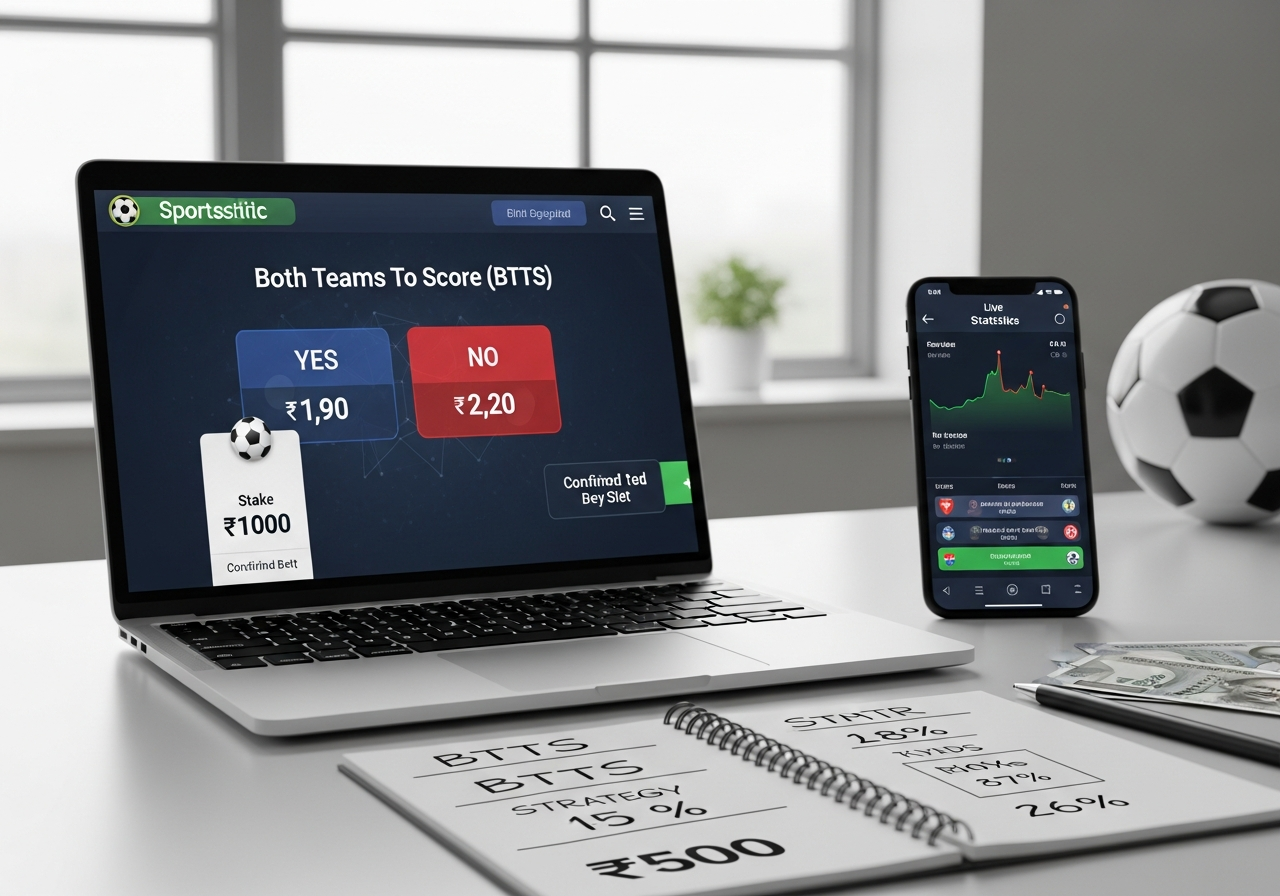
Both Teams To Score (BTTS) is one of the most straightforward and popular football betting markets available on Indian-facing sportsbooks today. Whether you’re new to sports betting or looking to refine your strategy, BTTS offers a simple yet engaging way to engage with football matches across leagues worldwide. This guide will walk you through everything Indian punters need to know: from basic rules and market variations to practical betting strategies, statistics to guide your decisions, and responsible gambling practices tailored to the Indian betting environment.
What Does Both Teams To Score (BTTS) Mean?
BTTS is a football betting market that asks a simple question: will both teams in a match score at least one goal each? Unlike match result betting (where you predict who wins), BTTS ignores the final scoreline. A 2–1, 1–1, or even 5–4 finish all result in a winning BTTS Yes bet, as long as both teams have found the back of the net at least once.
The market settles on goals scored during regular time—90 minutes plus injury time. Extra time and penalty shootouts do not count in standard BTTS markets unless the specific market listing explicitly states otherwise. Own goals count toward the team that benefits from them, so if a defender accidentally scores at their own end, that goal counts for the opposition.
BTTS Yes vs BTTS No Explained
- BTTS Yes: Both teams score at least one goal each. Examples: 2–1, 1–1, 3–2, 4–3, or any scoreline with goals from both sides.
- BTTS No: At least one team fails to score. Examples: 1–0, 0–0, 4–0, 3–0, or any result where one side is kept scoreless.
- Result is irrelevant: A 5–1 win for the favourite still counts as BTTS Yes because both teams scored. A 1–0 win also counts as BTTS No because only one team scored, regardless of which side won the match.
- Focus on scoring, not winning: Your bet depends entirely on whether both teams manage to score, not on who wins the match or by how many goals.
Key BTTS Rules For Indian Bettors
Most Indian-facing sportsbooks follow standard BTTS settlement rules. Own goals count toward the scoring team (the team that benefits), and goals are counted only during the 90 minutes of regular play plus any added injury time. If a match is abandoned or voided, your bet is typically returned or voided per the bookmaker’s terms and conditions.
Some Indian betting operators use alternative terminology for the same market. You may see BTTS labeled as GG/NG (Goals/No Goals), or simply as BTTS in the Goals or Specials section. The mechanics remain identical regardless of the label. Always check the specific market definition on your chosen platform if you’re unsure.
BTTS Market Variations You Will See Online
Indian sportsbooks offer several BTTS-related markets beyond the simple Yes/No binary. Understanding these variations helps you find betting opportunities that align with your confidence level and risk tolerance.
| BTTS Market Type | How It Works | Risk Level | Typical Odds Range |
|---|---|---|---|
| BTTS Yes/No | Both teams score at least one goal each. | Low | 1.70–2.20 |
| BTTS & Match Result | Both teams score AND a specific team wins (e.g., BTTS Yes & Home Win). | Medium | 2.50–4.50 |
| BTTS & Over/Under Goals | Both teams score AND the match total is over or under a set line (e.g., BTTS Yes & Over 2.5). | Medium–High | 2.00–3.80 |
| BTTS in Both Halves | Both teams score in the first half AND second half. | High | 3.50–6.00+ |
| BTTS 1st Half Only | Both teams score during the first 45 minutes. | Medium | 2.80–4.20 |
| BTTS 2nd Half Only | Both teams score during the second half (45–90 minutes). | Medium | 2.80–4.20 |
| BTTS & Player To Score | Both teams score AND a named player scores a goal. | High | 3.00–8.00+ |
Standard BTTS vs Combo BTTS Markets
The simplest BTTS bet is BTTS Yes or BTTS No—a straightforward outcome with modest odds usually hovering near 1.80 to 2.10 in balanced fixtures. Combo markets stack additional conditions on top of BTTS, creating higher odds but requiring multiple outcomes to align.
For example, BTTS & Win (such as BTTS Yes & Home Win) asks for both teams to score AND the home team to win. This requires two independent events to happen together, making the odds longer (often 3.00 to 4.50) but the probability lower. Similarly, BTTS in Both Halves requires both teams to score in the first 45 minutes AND again in the second half, a much rarer occurrence and reflected in odds of 4.00+.
These combo markets can be attractive when you spot a strong narrative (e.g., an attacking team facing a league opponent that also scores regularly), but they carry materially higher variance. Use combos sparingly and only when you have a clear edge.
How BTTS Bets Work Step By Step For Indian Users
Placing a BTTS bet on an Indian sportsbook is straightforward. Follow these steps to get your wager live:
- Log in to your Indian sportsbook account and navigate to the Football section (usually labeled as “Football” or “Soccer”).
- Find the Goals or Specials market where BTTS is typically grouped. Many platforms highlight BTTS near the top of goal-related markets for major leagues.
- Select your match from the available fixtures (Premier League, Champions League, Indian Super League, La Liga, Serie A, etc.).
- Click on BTTS Yes or BTTS No depending on your prediction. Some sites use toggle buttons; others display them as separate clickable options.
- Enter your stake in rupees (₹) into the bet slip. Most Indian platforms support rupee-denominated stakes from ₹10 upward.
- Review the odds and potential return (stake × odds) before confirming.
- Click Place Bet to submit your wager.
- Check your bet history after the match concludes to confirm settlement. Winning bets are credited immediately; losing bets are marked as voided if the match is abandoned.
Locating BTTS On Indian Betting Sites
BTTS appears in the Goals, Specials, or Markets section of most Indian sportsbooks. Major operators like Bet365, Betfair, Dafabet, and others place BTTS prominently because it’s one of the most popular goal markets. You’ll often see a simple Yes/No toggle or two separate betting boxes. Mobile apps mirror the desktop layout, making it just as easy to place BTTS bets on your smartphone while watching the match.
BTTS Betting Example With Rupee Stakes
Here’s a practical example for an Indian Super League match between two attacking teams:
You stake ₹1,000 on BTTS Yes at odds of 1.95 for a match between Bangalore and Mumbai City. If both teams score at least once (say, the match ends 2–2 or 2–1), your bet wins and you receive: ₹1,000 × 1.95 = ₹1,950 (a profit of ₹950). If only one team scores (e.g., 1–0 to Bangalore), your BTTS Yes bet loses and you forfeit the ₹1,000 stake.
Popular Leagues And Matches For BTTS In India
Indian bettors have access to BTTS markets across dozens of competitions. The most popular leagues and fixtures for BTTS betting include:
- English Premier League: Consistently high-scoring, open, attacking football makes BTTS a reliable market.
- UEFA Champions League: Elite European teams with potent attacks and variable defences create frequent BTTS opportunities, especially in group stages and later rounds.
- La Liga (Spain): High-scoring league with attacking-focused tactics; many matches feature both teams on the scoresheet.
- Serie A (Italy): Balanced league with strong attacking and defensive play; BTTS hits regularly.
- Indian Super League: Growing league with increasingly open, attacking football and good BTTS hit rates.
- Copa Libertadores & other domestic leagues: South American football is typically high-scoring and well-suited to BTTS strategies.
BTTS Trends In Indian Super League Fixtures
The Indian Super League has evolved into a more attacking, entertaining competition over recent seasons. Many ISL teams prioritise offensive play, which creates excellent BTTS opportunities. Derbies and top-table clashes between attacking sides (e.g., Bangalore vs Pune City) often show BTTS hit rates of 55–70%.
However, ISL matches also include fixtures where tactical caution or clear quality gaps reduce BTTS likelihood. Check team-specific BTTS percentages and recent form before betting. Strong attacking midfields and weak defensive records typically signal higher BTTS probability, while teams that concede few goals or play defensively suppress BTTS outcomes.
Reading BTTS Odds And Implied Probabilities
Understanding what BTTS odds mean helps you spot value and avoid mispriced bets. BTTS odds in balanced matches typically cluster between 1.80 and 2.20 for both Yes and No outcomes combined.
| BTTS Odds Format | Example Price | Approx. Implied Probability | What It Suggests About The Match |
|---|---|---|---|
| BTTS Yes at 1.70 | 1.70 | ~59% | Bookmaker thinks both teams scoring is likely; strong attacking teams or high-scoring league. |
| BTTS Yes at 1.90 | 1.90 | ~53% | Evens-style odds; balanced fixture with reasonable chance both teams score. |
| BTTS Yes at 2.20 | 2.20 | ~45% | Longer odds; bookmaker sees lower probability, possibly due to defensive mismatch or low-scoring teams. |
| BTTS No at 1.80 | 1.80 | ~56% | Bookmaker favours a single team keeping a clean sheet; defensive strength or attacking weakness likely. |
Implied probability is calculated as 1 ÷ odds. For example, 1.90 odds equal roughly 1 ÷ 1.90 = 52.6% implied probability (before the bookmaker margin). Shorter odds suggest higher probability; longer odds suggest lower probability and higher potential return if correct.
Why BTTS Odds Differ Across Matches
Several factors drive BTTS odds up or down:
- Attacking strength of both teams: High-scoring teams push BTTS Yes odds shorter.
- Defensive solidity: Strong defending teams lengthen BTTS No odds.
- League scoring averages: High-scoring leagues (Premier League, La Liga) see lower BTTS Yes odds than defensive leagues.
- Player injuries or suspensions: Loss of key attackers lengthens BTTS No odds; loss of key defenders shortens it.
- Weather and venue effects: Rain and poor pitches suppress scoring; altitude (if relevant) can affect both.
- Tactical approach: Teams playing high-press, attacking football inflate BTTS Yes odds; low-block, defensive set-ups do the opposite.
- Recent form: Teams in poor run of games (conceding many or scoring few) shift odds accordingly.
BTTS Odds vs Match Result Odds
BTTS and match result (1X2) betting are fundamentally different. Match result odds reflect who is expected to win; BTTS odds reflect only the likelihood that both teams score. A heavy favourite (e.g., Manchester City playing a lower-league team) might have 1X2 odds of 1.20 for a City win, but BTTS odds could still be near 1.90 if City regularly faces teams that score against them.
Conversely, a match where two similar teams are expected to contest an open game might have 1X2 odds near 1.95–2.05, yet BTTS could be as short as 1.60–1.70 because both sides are expected to find the net. Never assume BTTS odds based on match result odds.
Data And Statistics To Use Before BTTS Bets
Informed BTTS betting relies on data. Before placing a wager, check these metrics for both teams:
- BTTS percentage (BTTS hit rate): The % of matches where both teams scored. Look for teams consistently above 50–60% BTTS.
- Goals scored per match (average): Both teams’ offensive output. Higher averages increase BTTS Yes likelihood.
- Goals conceded per match (average): Defensive frailty inflates BTTS probability. Weak defences leak goals to both opponents.
- Expected goals (xG): Advanced metric showing true chance quality. High xG in both team profiles signals BTTS potential.
- Home vs Away splits: Some teams have drastically different BTTS rates at home vs away. Always check venue-specific stats.
- League BTTS frequency: Some leagues are naturally higher-scoring (e.g., Premier League, Ligue 1); others favour draws and low scores (e.g., defensive leagues).
- Recent form (last 5–10 matches): Teams in good offensive form or poor defensive run show elevated BTTS rates.
Prioritise teams with consistent BTTS hit rates of 55–65%+. Avoid betting BTTS on teams with sub-40% BTTS rates unless they face a notoriously leaky defence. Be cautious in knockout competitions where teams may abandon attacking play if leading, suppressing BTTS.
Using BTTS Stats Sites Effectively
Free stats sites like FlashScore, SofaScore, and ESPN provide BTTS percentage filters by league, home/away, and competition. Use these tools to quickly identify high-BTTS teams and matchups. However, avoid over-relying on small samples (e.g., a team’s BTTS from just 3 home games). Look for patterns across 10+ matches.
Combine statistics with context: a 65% BTTS team facing a 70%-BTTS opponent doesn’t automatically mean BTTS is a lock. Consider league averages, tactical fit, injuries, and whether the match carries extra intensity (derby, promotion decider) that might shift approach.
Core BTTS Betting Strategies Tailored For India
Different approaches suit different punters. Here’s a breakdown of popular BTTS strategies and how they compare:
| Strategy Name | Approach | Pros | Cons | Best Used In |
|---|---|---|---|---|
| Stats-Driven | Focus only on teams with 55%+ BTTS history, ignore emotion/news. | Systematic, repeatable, emotion-free. | Can miss context or form changes; mechanical. | Long-term consistent profitability through volume. |
| Form-Based | Select teams in good recent form (5+ matches), rising goal averages. | Captures momentum and current strength. | Hot streaks reverse; short-term variance high. | Mid-season when teams settle into rhythm. |
| Tactical Analysis | Pair high-BTTS teams with weak defences; avoid low scorers. | Holistic, context-aware; strong edge if correct. | Requires deeper knowledge; harder to execute. | When you spot clear attacking vs defensive mismatches. |
| Selective High-Value | Bet only where odds undervalue true BTTS probability (value spotting). | Maximises ROI; avoids low-odds traps. | Requires odds comparison and sharp analytics. | Against bookmaker inefficiency or public bias. |
| Knockout/Cup Angle | Shift to BTTS No in finals/decisive matches; teams play defensively. | Exploits tactical shift in tight matches. | Opposite strategy to league play; requires timing. | Cup finals, playoff deciders, must-win scenarios. |
Low-Risk BTTS Approach For Consistent Returns
Conservative BTTS betting prioritises long-term edge over short-term excitement. Target teams with consistent BTTS strike rates of 55–65%, bet only ₹500–₹1,000 per bet (1–2% of bankroll), and avoid chasing losses through larger accumulators.
Place BTTS bets 2–3 times per week maximum across markets where you see genuine edge, rather than betting BTTS on every available match. Accept that some weeks yield fewer bets; quality over quantity. This approach generates steady returns (3–7% ROI) over a season without the variance swings of high-risk strategies.
High-Risk BTTS Combos And When To Avoid Them
BTTS & Win, BTTS in Both Halves, and multi-leg BTTS accumulators (e.g., BTTS across 4–5 weekend matches) are high-variance plays. Each added condition multiplies risk. A BTTS & Win combo at 3.50 odds requires both teams to score AND a specific team to win—two independent events that could easily both fail.
Reserve combos for occasional recreational bets or when you have exceptional confidence in a narrative (e.g., a high-BTTS team you expect to win with both sides scoring in an open match). Treat combos as fun plays, not core strategy.
Common BTTS Mistakes And How To Avoid Them
Avoiding these pitfalls will improve your BTTS results immediately:
- Ignoring team news and injuries – Missing that a top striker is suspended. Correction: always check team news 1–2 hours before kick-off; missing key attackers reduce BTTS probability.
- Overvaluing brand names without defensive context – Assuming Manchester United will generate BTTS because of their status. Correction: check their recent goals conceded, not just attacking strength.
- Misunderstanding extra time in standard BTTS – Placing BTTS bets in cup matches without realising extra time doesn’t count. Correction: confirm the BTTS market definition; if it covers 90 minutes only, avoid bets where outcomes might be decided in ET.
- Over-using BTTS in large accumulators – Chasing losses by bundling BTTS across 6+ matches at low combined odds. Correction: limit accumulators to 3 legs maximum, all high-quality selections.
- Betting without league context – Applying Premier League BTTS tendencies to a defensive lower-league match. Correction: adjust expectations per competition; some leagues naturally generate fewer two-way scorelines.
- Neglecting venue and form – Forgetting that a team’s BTTS rate at home differs from away. Correction: always check home/away splits before betting.
Bankroll And Stake Management For BTTS
Poor stake management often stems from the same emotional errors that create the above mistakes. Set a total BTTS bankroll (e.g., ₹10,000) and fix a unit size (₹500 per bet = 5% of bankroll). Never exceed 2 units per bet, even if you feel “sure.” After losses, resist the urge to stake larger amounts to “recoup” losses.
Avoid betting while tilted (emotionally upset after a loss or win). Goals markets have high variance—even perfect systems experience 3–4 losing streaks in a row. Accept variance and bet mechanically per your plan.
BTTS In Accumulators And Bet Builders
BTTS is hugely popular in accumulators because it boosts odds while remaining intuitive. However, combining BTTS across multiple matches multiplies risk. An 80% BTTS hit rate per match drops to (0.80)^5 = 32.8% if you combine five matches, assuming independence.
| Use Case | How BTTS Is Added | Potential Upside | Key Risks |
|---|---|---|---|
| Weekend acca (3 legs) | BTTS Yes on 3 Premier League matches, odds 1.90 each. Combined: 1.90^3 = 6.86. | ₹1,000 stake → ₹6,860 return (₹5,860 profit). | All 3 matches must hit; any failure loses entire bet. |
| Bet builder (single match) | BTTS Yes + Over 2.5 Goals + Home Win. | Odds ~3.50 on single match; single slip to examine. | Only 1 match risk, but 3 conditions must align. |
| Cross-league acca (5 legs) | BTTS across ISL, Premier League, and Serie A. Combined: ~30x. | Large potential return (₹1,000 → ₹30,000). | Very low hit rate; high variance. Only for recreational play. |
| Asian handicap + BTTS | Bet builder mixing BTTS with goal spread (e.g., Home -0.5 goals, BTTS Yes). | Tailored odds reflecting specific match narrative. | Requires understanding multiple market mechanics. |
Structuring Sensible BTTS Accas
Limit BTTS accumulators to 3 legs maximum unless you’re placing truly recreational stakes (₹100–₹200). Choose only high-quality BTTS selections (teams with 55%+ BTTS records facing similar-quality opponents). Avoid combining mismatched fixtures (e.g., a high-BTTS match paired with a defensive low-scoring match) as this reduces overall hit rate without equivalent odds boost.
If using a 3-leg acca, aim for combined odds of 4.50–6.00. Higher odds require lower probability, increasing variance. Anything above 8.00 combined signals at least one weak selection—reconsider before betting.
When BTTS Bet Builders Make Sense
Bet builders (same-match multi-selections) work best when you’re constructing a coherent narrative. For example, if you believe a match will be open and attacking (both teams likely to score) with 3+ total goals, pairing BTTS Yes with Over 2.5 Goals makes sense—both outcomes flow from the same expectation.
Avoid random add-ons like BTTS Yes + Red Card or BTTS Yes + First Goal Scorer unless you have genuine conviction on all conditions. Stick to goal-related combinations (BTTS + Over/Under, BTTS + Match Result) where outcomes are correlated and easier to assess.
Legal And Responsible BTTS Betting In India
Online betting in India operates in a complex legal landscape. Some states permit it under licensed operators; others restrict it. Most Indian bettors use offshore platforms (licensed in jurisdictions like Malta or Curacao) that accept Indian players.
- Choose regulated, reputable operators: Ensure your chosen sportsbook holds valid gaming licenses and operates transparently. Check user reviews and regulatory status before depositing.
- Verify age and identity: All licensed operators require KYC (Know Your Customer) documentation. You must be 18+ to bet legally; casinos verify this through PAN, Aadhaar, or passport upload.
- Understand local laws: While many states don’t explicitly forbid online betting, some do restrict it. Consult local regulations or avoid betting if unsure.
- Use secure payment methods: Deposit and withdraw via trusted Indian payment gateways or international cards. Avoid unverified platforms offering unsafe payment routes.
- Set deposit and loss limits: Most operators offer tools to cap daily, weekly, or monthly deposits and self-exclude if needed. Use these proactively.
- Never chase losses: Treat BTTS betting as entertainment with a fixed budget, not as income or a recovery strategy for financial shortfalls.
Setting Limits And Recognising Problem Behaviour
Set a monthly BTTS betting budget (e.g., ₹5,000) and stick to it strictly. Use your sportsbook’s deposit limit tool to enforce this automatically. Track all bets in a spreadsheet; if losses exceed 20% of your monthly budget, take a 1–2 week break.
If you notice yourself betting more frequently, chasing losses, hiding betting activity, or using borrowed money, these are warning signs. Contact your platform’s support team to self-exclude (typically a 6-month to permanent account suspension), or reach out to organisations like the National Council for Mental Health in India for confidential counselling.
Responsible betting ensures BTTS remains enjoyable and doesn’t harm your finances or wellbeing. Enjoy the strategy and analysis; accept losses as part of the game.