
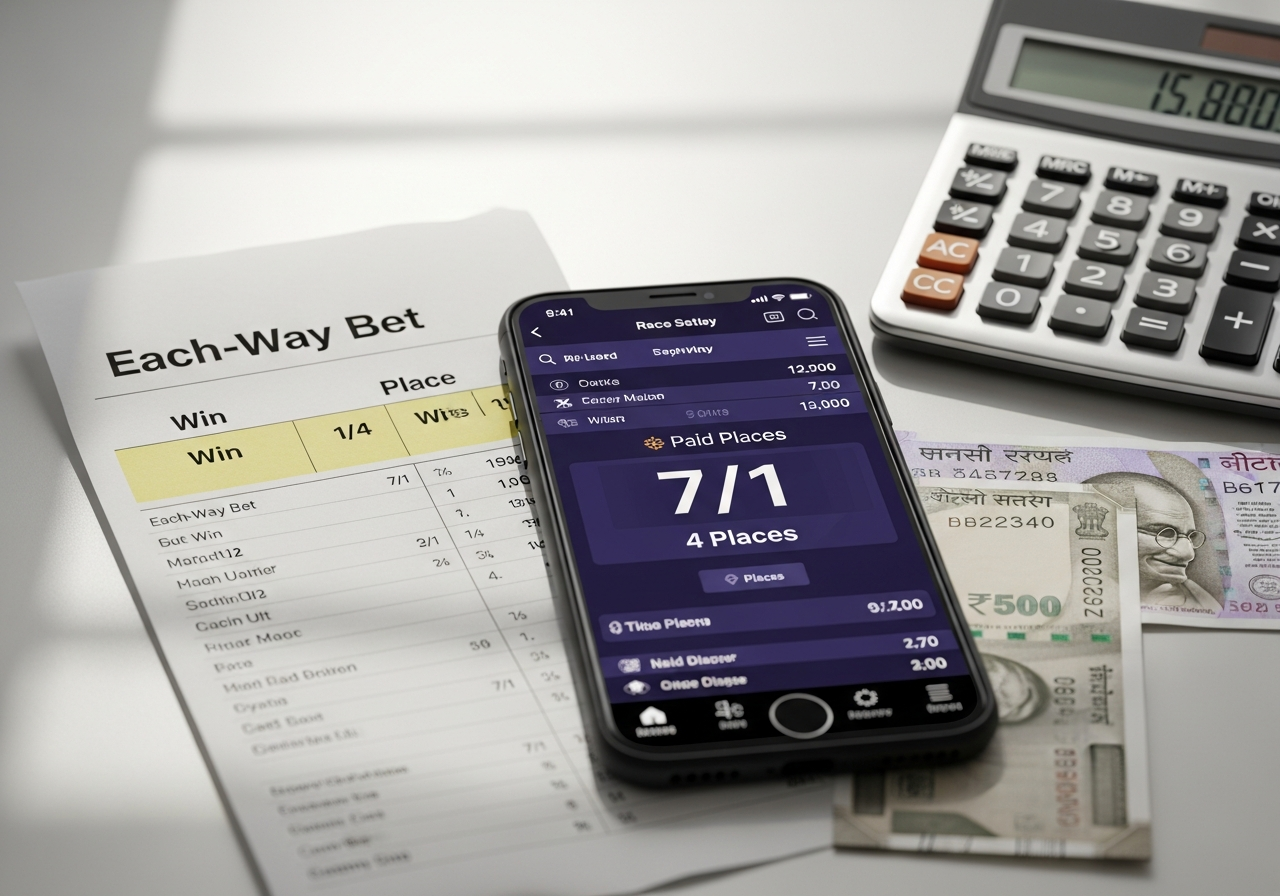
For Indian horse racing enthusiasts, understanding each-way betting can transform how you approach race days, offering a balanced way to protect your bankroll while maintaining exposure to winning selections. An each-way bet is essentially two equal wagers combined into one: a bet for your horse to win and a separate bet for it to place in the race. This dual approach means you can profit even if your selection doesn’t cross the finish line first, provided it finishes within the designated place positions.
This guide is tailored specifically to Indian punters, covering local racecourses like Mahalakshmi in Mumbai and Bangalore Turf Club, along with how each-way betting works through the fixed-odds bookmakers and online platforms that serve the Indian market. Unlike traditional tote betting found at some Indian racecourses, each-way bets with offshore and international bookmakers operate on fixed odds, giving you certainty about potential returns before you stake. Understanding this betting type is particularly valuable for Indian bettors managing moderate bankrolls who want to reduce variance while still capturing upside on well-researched selections.
What Is an Each-Way Bet in Horse Racing?
An each-way bet splits your total stake equally between two independent wagers on the same horse. If you place a ₹500 each-way bet, you’re actually risking ₹1,000 total: ₹500 on the win and ₹500 on the place. This is a fundamental distinction that many new Indian bettors overlook—your bankroll commitment doubles immediately when you choose each-way over a simple win bet.
The concept originated in global horse racing and has been standardised across major betting jurisdictions. In India, each-way betting is predominantly offered by fixed-odds bookmakers operating online and offshore rather than through the pari-mutuel tote systems used at some on-course betting windows. This means the odds and place terms are set by the bookmaker before the race, not determined by the pool of money wagered by all bettors. This distinction is important because it allows Indian punters to compare odds across different platforms and make informed decisions about stake sizing and value.
Win Part vs Place Part Explained
The win component of an each-way bet functions identically to a straightforward win wager. Your horse must finish first for this part to return a profit. If you bet ₹500 to win at odds of 5/1, that part returns ₹3,000 (₹500 × 6) if your horse wins, or zero if it finishes anywhere else.
The place part is where each-way betting differentiates itself. This portion of your stake wins if your horse finishes within the designated place positions—usually the first two, three, or four positions depending on field size and race type. Importantly, place odds are always a fraction of the win odds, commonly 1/4 or 1/5. Let’s work through a concrete example: you place ₹500 each-way on a horse at 8/1 with place odds of 1/5. If your horse finishes second, the win part loses completely, but the place part returns ₹600 (₹500 × 1.2, calculated as ₹500 × (1/5 of 8/1 + 1)). Your total return is ₹600, meaning a net loss of ₹400 on the original ₹1,000 stake.
How Each-Way Differs From Win, Place and “Across the Board”
A win-only bet is the simplest form—your stake returns only if your horse finishes first. It requires greater confidence and higher odds to justify the risk, but if successful, delivers undiluted odds. A place-only bet covers only the place part; you don’t win if the horse comes first, and you forfeit the opportunity to capitalise on the full winning odds.
Each-way combines both, giving you “two bites of the cherry.” This comes at the cost of doubling your stake. An “across the board” bet, more common in certain international markets, is actually three equal bets: win, place, and show (finish in the top three). Indian bettors rarely encounter across-the-board betting in their domestic market, though some international betting sites may offer it for overseas races.
The strategic trade-off is clear: each-way reduces your profit potential on winners compared to a full-stake win bet, but significantly increases your chances of any return. For a ₹500 bet to win at 5/1, a win yields ₹2,500 profit. That same ₹500 split each-way (₹250 win, ₹250 place at 1/4) profits only ₹750 if the horse wins, but at least returns ₹250 if it places, versus a complete loss with win-only.
Each-Way Betting Rules and Place Terms
| Race type / runners | Typical places paid | Place odds fraction (global) | Likely EW terms for Indian punters |
|---|---|---|---|
| Non-handicap 5–7 runners | 2 places | 1/4 | 2 places, 1/4 odds |
| Non-handicap 8–11 runners | 3 places | 1/4 or 1/5 | 3 places, 1/5 odds |
| Non-handicap 12+ runners | 4 places | 1/4 | 4 places, 1/4 odds |
| Handicap 5–7 runners | 2 places | 1/4 | 2 places, 1/4 odds |
| Handicap 8–11 runners | 3 places | 1/5 | 3 places, 1/5 odds |
| Handicap 12+ runners | 4 places | 1/4 or 1/5 | 4 places, 1/4 odds |
| Group 1 / major race | 4 places | 1/4 | 4 places, 1/4 odds (standard) |
Each-way betting operates under standardised place rules that determine how many finishing positions count as a “place” and what fraction of the win odds applies to the place bet. In smaller fields (5–7 runners), only the first two positions typically count as places, and the place odds are usually 1/4 of the win price. As field size increases, bookmakers extend the number of places and sometimes tighten the fraction. A 12-runner handicap might offer 4 places at 1/4, while some 8–11 runner races drop to 1/5 place odds to manage bookmaker risk.
These global standards are broadly reflected in the terms offered by international and offshore bookmakers serving Indian punters. However, terms can vary by bookmaker, and special promotions during major race meetings (such as the Indian Derby or the Invitation Cup) may offer enhanced place terms or extra places as a promotional tool.
Field Size and Its Impact on Each-Way Value
Field size is the primary driver of each-way value. In a 5-runner race with only 2 places available, your horse must beat at least 3 others to qualify for a place return. That’s a mathematical hurdle of 60% of the field. In a 16-runner field with 4 places, your selection only needs to beat 12 others—a 75% barrier, mathematically easier to clear.
Larger fields also typically come with better place odds fractions. A 14-runner handicap at Bangalore Turf Club might offer 4 places at 1/4, giving the place part real value when combined with a longish winning price. Conversely, a 6-runner race at Mahalakshmi with 2 places at 1/4 offers minimal place protection—the horse must genuinely be competitive to justify each-way staking.
Before placing an each-way bet, Indian bettors should always check the racecard for field size and confirm the exact EW terms their bookmaker is offering. Not all platforms display these terms equally, and a few seconds spent verifying place count and odds fraction can mean the difference between a mathematically sound play and a poor value bet.
How Each-Way Payouts Work for Indian Bettors
| Outcome | Win part result | Place part result | Total return on a ₹1,000 stake example |
|---|---|---|---|
| Horse wins | ₹500 stake × 4/1 = ₹2,500 return | ₹500 stake × (1/4 of 4/1 + 1) = ₹625 return | ₹3,125 total (profit ₹1,125) |
| Horse places (2nd–4th) | Loss: ₹500 stake lost | ₹500 stake × 1.25 = ₹625 return | ₹625 total (loss ₹375) |
| Horse finishes out of money | Loss: ₹500 stake lost | Loss: ₹500 stake lost | ₹0 return (loss ₹1,000) |
| Horse wins (at 10/1, place 1/4) | ₹500 × 11 = ₹5,500 return | ₹500 × 3.5 = ₹1,750 return | ₹7,250 total (profit ₹5,250) |
| Horse places (at 10/1, place 1/4) | Loss: ₹500 lost | ₹500 × 3.5 = ₹1,750 return | ₹1,750 total (loss ₹750) |
The payout structure for each-way bets revolves around three distinct outcomes. First, if your horse wins, both the win and place parts return profits based on the full win odds and the place odds fraction respectively. A ₹1,000 each-way bet (₹500 + ₹500) on a 4/1 shot that wins generates ₹2,500 from the win part and ₹625 from the place part, totalling ₹3,125 returned and ₹1,125 net profit.
Second, if your horse finishes in the place positions but not first, only the place part returns a profit. The win component is forfeited entirely. On the same ₹1,000 stake with place odds at 1/4, a placed finish at 4/1 returns only ₹625 from the place part, for a net loss of ₹375. This outcome is where each-way bets shine for mid-range selections—you recover most of your stake while a straight win-only bet would be a total loss.
Third, if your horse finishes outside the place positions, you lose both parts entirely. A ₹1,000 each-way bet that doesn’t place returns nothing. This is why understanding field size, place count and your horse’s true winning chances is critical before committing capital.
Worked Example: Each-Way Bet on an Indian Race
Consider a realistic 12-runner handicap at Bangalore Turf Club. You’ve identified a horse at 7/1 with place odds set at 1/4 (standard for this field size). You decide to place a ₹600 each-way wager.
Your total outlay is ₹1,200 (₹600 win + ₹600 place). If your horse wins, the win part returns ₹600 × 8 = ₹4,800, and the place part returns ₹600 × 3 = ₹1,800 (calculated as ₹600 × (1/4 of 7/1 + 1) = ₹600 × 2.75). Total return is ₹6,600, yielding ₹5,400 net profit.
If your horse finishes in the top four positions but not first (likely outcome given the odds), the win part loses ₹600, but the place part returns ₹1,800. You recover ₹1,800 of your ₹1,200 stake, netting a ₹600 loss. This is substantially better than a ₹600 win-only bet, which would have returned nothing.
If your horse finishes fifth or worse in the 12-runner field, both parts lose and you’re down ₹1,200. The mathematics here are transparent: at 7/1 in a 12-runner field, your horse has an implicit winning probability of roughly 12.5% (1/8), and a placing probability that depends on its class and form relative to the field.
Understanding Place Odds Fractions (1/4 vs 1/5)
Place odds fractions directly impact the profitability of the place component. A 1/4 fraction means the place odds are one-quarter of the win odds plus one. A horse at 8/1 with 1/4 place odds returns place-winning odds of 2/1 plus the stake (a 3/1 multiplier). The same horse at 1/5 place odds returns 1.6/1 plus the stake (a 2.6/1 multiplier).
The practical difference is stark on longer prices. On a 20/1 shot, 1/4 place odds offer 5/1 for the place part, while 1/5 offers just 4/1. Over a series of placed bets at longer odds, the 1/4 fraction delivers materially better value. Indian bettors should always prefer 1/4 terms when available, particularly when backing selections at 6/1 or higher.
Bookmakers tighten from 1/4 to 1/5 as a way to manage their liability in larger fields or on heavily backed races. In a 14-runner handicap where money floods in on three or four popular selections, offering 1/5 place odds instead of 1/4 reduces their exposure to multiple placed finishes. Understanding this dynamic helps Indian punters identify soft markets and avoid races where the bookmaker has already priced in heavy support.
Legal and Practical Context of Each-Way Betting in India
- Domestic horse race betting legality: Horse racing is one of the few forms of betting explicitly permitted under Indian law, regulated primarily under state jurisdiction. Major racecourses like Mahalakshmi in Mumbai and Bangalore Turf Club operate licensed on-course tote pools, where betting is legal and monitored. However, on-course totes typically offer pari-mutuel betting rather than fixed-odds each-way markets.
- Fixed-odds bookmakers and offshore platforms: Each-way betting with fixed odds is predominantly accessed through international betting sites licensed outside India. These platforms accept Indian customers, process INR deposits via UPI, cards and other local payment methods, and operate legally in their home jurisdictions (UK, Malta, Isle of Man, etc.). Indian punters must verify the platform’s licensing and compliance with their own regulatory stance.
- KYC requirements and documentation: Legitimate international bookmakers operating in the Indian market require Know-Your-Customer (KYC) verification, including identity and address proof, before allowing deposits and withdrawals. This regulatory requirement protects both the operator and the player but also means your account is tracked and verified. Use official documents such as Aadhaar, PAN or a bank statement.
- Payment methods for Indian users: Major platforms accept INR deposits through UPI, NEFT, debit cards, and digital wallets. Withdrawals typically return to the same method used for deposit. Processing times vary (instant for UPI to 1–2 business days for bank transfers), and some platforms apply transaction fees. Compare payment options across bookmakers before choosing where to bet.
- Responsible gambling safeguards: Licensed platforms offer deposit limits, session time limits, self-exclusion and links to gambling addiction resources. These tools are present not just to satisfy regulators but to protect your financial wellbeing. Use them proactively rather than as an afterthought.
Where Indian Punters Can Find Each-Way Markets
Each-way betting is available on international sites that explicitly target or accept Indian customers. These include major European bookmakers, exchange platforms and specialised horse racing betting sites. Not every platform offers EW on every race; domestic Indian races may have limited coverage compared to UK, Irish or Australian racing. Indian bettors often find richer EW markets on international Group 1 races like the Grand National, Cheltenham races or Royal Ascot, where bookmakers extend full each-way options.
Some international racing platforms maintain partnerships with Indian racecourses and may carry EW markets on major Indian races such as the Indian Derby or Invitation Cup, though this is sporadic and depends on licensing agreements. Checking multiple platforms on race day is advisable because EW terms can differ—one bookmaker might offer 4 places at 1/4 while another offers 3 places at 1/5 on the same race, significantly altering the expected value of your bet.
Pros and Cons of Each-Way Betting for Indian Horse Racing
| Aspect | Pros for Indian punters | Cons / risks | Typical use case |
|---|---|---|---|
| Variance reduction | EW provides a safety net; placed finishes cushion losses on well-researched selections | Doubled stake increases overall bankroll exposure; can erode capital faster if selections perform poorly | Horses with solid form in large fields where placing is realistic |
| Longshot exposure | Each-way allows backing longer odds (8/1+) with defined downside; place return on a big price can yield meaningful profit even without winning | Place odds shrink significantly at very long odds (15/1+); place fraction of 1/5 on a 25/1 shot offers minimal value | Selections at 6/1–15/1 range in 12+ runner fields |
| Bookmaker edges and margins | Fixed odds are transparent; you know exact payout before staking; no tote pool variance | Bookmaker margins on place odds (typically 10–15%) reduce expected value vs mathematical probability | Comparing odds across platforms to find best value |
| Bankroll impact | EW is suitable for smaller stakes due to capital efficiency; can protect modest Indian bankrolls | Each ₹500 EW bet requires ₹1,000 outlay; frequency of betting combined with EW doubling can deplete smaller bankrolls rapidly | Casual weekly betting rather than daily multiple bets |
| Emotional discipline | EW can prevent “all-or-nothing” psychology; placed finish feels like progress, encouraging longer-term thinking | Risk of using EW as emotional insurance without proper value assessment; can lead to habitual staking regardless of odds | Structured, selective betting rather than reactive market-chasing |
When Each-Way Is Better Than Win-Only
Each-way outperforms win-only betting in several specific scenarios. First, when you’ve identified a solid selection at generous odds in a large field. A horse at 8/1 in a 14-runner handicap with realistic chances of placing has natural each-way value. The place part hedges the risk while the win part captures full value if your edge analysis is correct.
Second, each-way suits mid-table selections—horses that are unlikely to be heavy favourites but have genuine form credentials. A ₹800 each-way bet on a 6/1 shot in a 12-runner race often represents better expected value than an ₹800 win-only bet on a 2/1 favourite with heavy bookmaker margin already priced in.
Third, each-way becomes compelling when bookmakers offer promotional extra-place terms. During major race meetings like the Indian Derby, some platforms extend to five or six places on selected races. A 16-runner race that normally offers 4 places at 1/4 but temporarily offers 5 places at 1/5 changes the maths materially in the each-way bettor’s favour.
Situations Where Each-Way Is a Poor Choice
Each-way should be avoided when the odds are short relative to the likely probability. Backing a 2/5 favourite each-way on a 6-runner race virtually guarantees a loss; the win part is heavy odds-on, the place odds are cramped (likely 1/4 of 2/5 = 3/10), and the ₹1,000 stake for every ₹500 units represents poor capital efficiency.
Small fields pose a second challenge. In a 5-runner race with only 2 places, your horse must finish in the top 40% of runners just to get a place return. If you lack genuine conviction that your selection beats 3 of the 4 rivals, the risk/reward of each-way is unfavourable compared to win-only at better odds.
Third, avoid each-way on races with very unfavourable place terms. A race offering only 2 places at 1/5 in a 10-runner field is unattractive; the place barrier is high and the odds are suppressed. Finally, don’t use each-way emotionally—as a safety blanket to justify betting selections you don’t truly rate. The doubled stake and split odds mean you need genuine value for each-way to outperform simpler wagering strategies.
Key Each-Way Betting Strategies for Indian Punters
- Focus on larger fields and generous place terms: Prioritise races with 12+ runners and bookmaker offers of 4 places at 1/4 odds. These races have the best risk-adjusted each-way potential; you’re backing a selection with multiple escape routes to profitability.
- Identify overlays in the place market: Compare the bookmaker’s place odds against the implied probability. If a horse is 6/1 to win but the place odds are 1/4, that 1/5 multiplier (1.5/1 place odds) should be 1.75/1 if odds were fair. Backing such overlays over many races builds long-term edge.
- Exploit promotional extra-place offers: On major race days, watch for bookmakers extending to 5 or 6 places temporarily. A horse that would be marginal each-way at 4 places becomes clearly positive at 5 places; calculate the expected value shift before deciding.
- Avoid heavy favourites unless odds are exceptional: Short-priced selections (under 3/1) have diminishing each-way value because the place odds compress dramatically and your stake is mostly wasted on likely losing outcomes. Back favourites only if you have contrarian conviction at genuine overlay odds.
- Combine EW with single bet for selected races: Rather than blanket each-way betting, reserve EW for races meeting specific criteria: strong form analysis, generous odds, large field, good place terms. Use simpler win bets on less clear-cut selections.
- Document your EW bets and review margins: Keep records of each-way stakes, odds, place terms and settlement. Over 20–30 bets, you’ll identify whether you’re finding genuine value or simply increasing variance through poor selection criteria.
Longshot and Extra-Place Opportunities
Longshots shine in each-way betting because the place odds compound the expected value. A 15/1 shot in a 14-runner field with 1/4 place odds offers 3.75/1 for the place part. If your form analysis suggests the horse has a genuine 4–5% chance of winning and a 15–20% chance of placing, the expected value of the place part alone justifies an each-way bet.
Extra-place promotions amplify this advantage. During major Indian race meetings or international racing like the Grand National, bookmakers regularly extend from 4 to 5 or 6 places as a promotional tool. A longshot that’s marginal each-way at 4 places becomes profitable at 5. Indian punters should set a calendar reminder for major race days and check for such promotions before finalising stakes.
Bankroll Management and Stake Sizing for Each-Way Bets
- Double your intended stake size in bankroll calculations: An each-way unit of ₹300 requires ₹600 from your betting bank. Factor this into your overall allocation so EW betting doesn’t artificially accelerate bankroll depletion.
- Size EW stakes conservatively relative to win bets: If your standard win bet unit is ₹500, consider an EW unit of ₹300 (total ₹600 outlay). This maintains consistent exposure while respecting the doubled stake mechanics of each-way betting.
- Adjust unit sizes based on field and place terms: In a small field with poor place terms (5 runners, 2 places at 1/5), drop to half your normal EW unit. In a large field with great terms (16 runners, 4 places at 1/4), you can maintain or slightly increase unit size.
- Monitor cumulative EW exposure across race days: If you’re placing EW bets across multiple meetings, track total capital at risk. Five ₹500 each-way bets represents ₹5,000 in play—a meaningful portion of a typical Indian bettor’s bankroll.
Setting Realistic Unit Sizes in INR
The foundation of bankroll management is selecting an appropriate unit size. For a typical Indian recreational bettor with a ₹20,000 betting bank, a ₹200–300 unit represents 1–1.5% of capital. An each-way bet at ₹200 per side (₹400 total) sits comfortably within this framework without creating undue pressure. If your bank is ₹50,000, a ₹500 unit per side (₹1,000 EW) maintains the same percentage exposure.
Progressive bettors might increase units after a winning sequence or decrease them after a losing run, but the key discipline is maintaining percentage-based sizing rather than fixed rupee amounts. A ₹500 EW bet on someone’s ₹10,000 bank is reckless (10% unit); the same stake on a ₹100,000 bank is measured (1% unit).
Avoiding Chasing Losses with Each-Way Bets
The psychological trap of using each-way to recover losses deserves explicit attention. After a string of losses, the temptation to “just get even” through larger each-way stakes on longer odds is real but corrosive. Each-way betting, by nature, offers modest expected value at best; it is not a recovery vehicle. Chasing with each-way bets compounds losses through increased variance and poor decision-making.
Set a daily or weekly loss limit and stop betting once reached. If you’ve lost ₹2,000 on a race day, closing your account until the following week is the mathematically and psychologically sound choice. Each-way’s appeal is as a structured, disciplined tool for finding value in large-field races, not as an instrument for emotional recovery.
Comparing Each-Way Odds and Place Terms Across Bookmakers
| Bookmaker type | Typical EW place fraction | Standard places | Extra-place offers | Notes for Indian users |
|---|---|---|---|---|
| Traditional fixed-odds shops (online) | 1/4 standard, 1/5 on some races | 3–4 places depending on field | Rare; occasional major race promotions | Consistent terms; easy to compare; may have lower max bet limits |
| Exchange platforms | Variable based on market liquidity | Determined by lay odds available | Extra place markets sometimes available | Best value if you shop both win and place markets separately; steeper learning curve |
| Specialised horse racing sites | 1/4 predominant; occasionally 1/5 | 3–4 places standard | Frequent on featured races; 5–6 places common | Focused racing expertise; better odds depth; generous promotions |
| Indian-facing brands | Typically 1/4 or 1/5 | 2–3 places on Indian races | Sporadic during major meetings | Limited race coverage; terms may be less favourable than international books |
Each-way odds and place terms vary considerably across bookmakers. A race offering 4 places at 1/4 on one platform might be 3 places at 1/5 on another, or the place odds might differ slightly due to each bookmaker’s margin structure. Checking two or three platforms before committing stake is standard practice among experienced Indian bettors.
Traditional fixed-odds shops tend toward consistent, generous terms (1/4 place odds) on major races because they attract volume. Exchanges offer best-price opportunities if you’re willing to lay bets and accept variable odds, though Indian users sometimes find exchanges less intuitive than traditional bookmakers. Specialised racing sites cater to serious bettors and often feature promotional extra places on featured races—a valuable edge worth exploiting.
Using Exchanges and Place Markets for Better Value
Exchange platforms like Betfair allow you to view and bet the place market separately from the win market. Rather than accepting a bookmaker’s fixed 1/4 place odds fraction, you can compare the actual place odds offered by other backers and lay-bettors and decide whether they represent value relative to your probability estimates.
On a race with 14 runners offering 4 places, if a horse is 6/1 on the win market but the place odds are quoting 2/1 (instead of the bookmaker’s fixed 1/5, which would be 1.5/1), the exchange place market is offering better value. Savvy Indian bettors use exchanges to cherry-pick the place part when it’s favourable and use traditional books for the win component, essentially creating a custom each-way bet with superior terms.
This requires more effort and multiple accounts, but for serious bettors tracking each-way value over seasons, combining exchange place markets with traditional bookmaker win odds is a valid optimisation strategy.
Applying Each-Way Betting to Popular Indian Horse Races
Each-way betting gains particular traction on major Indian race meetings where field sizes expand and prize money attracts quality fields. The Indian Derby, run annually at Mahalakshmi Racecourse, typically features 10–16 runners in a handicap format—a classic each-way field. The Invitation Cup at Bangalore Turf Club and the 1,000 Guineas at Mahalakshmi likewise attract competitive fields where each-way value emerges.
These prestigious races attract international bookmaker attention, meaning competitive each-way terms are typically available. During such meetings, Indian punters have access to full EW markets with good place terms, promotional extra places, and sufficient liquidity to place meaningful bets without moving odds excessively.
Midweek maidens or lower-class handicaps at regional meetings often feature smaller fields (5–8 runners) and less attractive each-way terms, making them poor targets for EW staking. The best value emerges on Group races, conditions races, and handicaps with 12+ runners at established meetings.
Case Study: Each-Way on a Major Mumbai or Bengaluru Handicap
Consider the Invitation Cup at Bangalore Turf Club, a prestigious 2,000m handicap typically attracting 14 runners. You’ve identified a horse trained by a leading handler, coming off a close second at a similar track, weighted favorably in the handicap, and priced at 7/1. The field is competitive but not overcrowded with obvious champions.
Your analysis suggests the horse has a realistic 10–12% winning probability (roughly 8/1 true odds) and a 25–30% placing probability given the field strength and your horse’s class. Bookmakers are offering 4 places at 1/4. You place ₹500 each-way (₹1,000 total outlay).
The mathematics are clear: you’re slightly backing the odds on the win (your 12.5% implicit price vs 8.3% win odds) and materially backing the odds on the place (your 30% probability vs roughly 18% place odds of 1/4). If this analysis is sound, this each-way bet has positive expected value.
The race runs, and your horse finishes third. The win part loses ₹500, but the place part returns ₹500 × 3 = ₹1,500 (at 1/4 of 7/1 = 2/1 place odds). You receive ₹1,500 for your ₹1,000 stake, netting ₹500 profit. Over a season of similar plays, this selective, value-based approach compounds into meaningful returns.
International Races Bet on From India
Indian bettors frequently place each-way bets on international races—the Grand National, Cheltenham Festival, Royal Ascot, and major Australian/New Zealand racing. These races offer ample liquidity, competitive odds, and bookmakers extending generous each-way terms as a matter of course. The Grand National, with 40 runners and standard 4 places, is a classic each-way race where the place odds alone can deliver value on well-fancied runners.
International racing provides Indian punters with deeper analysis possibilities (form databases, sectional timing, trainer records) and more stable, larger betting pools. The odds are also typically sharper, reflecting global rather than local betting patterns. When learning each-way betting, international racing offers clearer signals and more straightforward comparisons because the datasets are transparent and the races are widely covered.
Responsible Each-Way Betting for Indian Punters
- Set a dedicated betting bank separate from everyday finances: Open a separate account at your bookmaker and fund it with money set aside specifically for betting. This creates psychological separation and prevents betting capital from mingling with bill payments or savings.
- Define maximum daily, weekly and monthly loss limits: Before the racing calendar begins, decide the maximum you’re willing to lose across each timeframe. If you lose ₹2,000 weekly, cease betting until the week resets. This brake prevents streaks from spiralling into financial harm.
- Understand each-way betting does not guarantee profits: Each-way reduces variance but does not eliminate losing bets. Emphasise that a “safe” each-way bet that doesn’t place is still a loss. No betting strategy guarantees returns over short timeframes.
- Avoid using EW to justify overextending bankroll: If a ₹500 win bet feels too large for your bank, a ₹500 each-way bet (₹1,000 total) is substantially worse because you’re doubling the outlay. Resist the temptation to use EW as a rationalization for larger stakes.
- Review your betting activity monthly and track profitability honestly: Many casual bettors underestimate losses because they don’t track systematically. Use a spreadsheet to log stakes, odds, results and P&L. After 20–30 bets, you’ll have clarity on whether your approach is working or whether adjustments are needed.
Checklist Before Placing an Each-Way Bet
Before every each-way wager, run through this mental checklist: First, confirm the field size and place count. Does a 6-runner race with only 2 places justify your stake, or would a win-only bet be clearer? Second, check the place odds fraction. Is the bookmaker offering 1/4 or 1/5? Have you calculated whether the place part represents value relative to your probability estimate?
Third, verify your horse’s true winning chances against the odds and field strength. Does a 6/1 price align with realistic analysis, or is this a lazy, emotional selection? Fourth, confirm your stake size respects your bankroll limits. Is a ₹600 each-way (₹1,200 total) appropriate given your bank size and previous day’s results? Finally, check whether promotional terms apply—are extra places available today that shift the value equation?
This pre-bet discipline takes 60 seconds and prevents impulsive mistakes that cascade into losses.