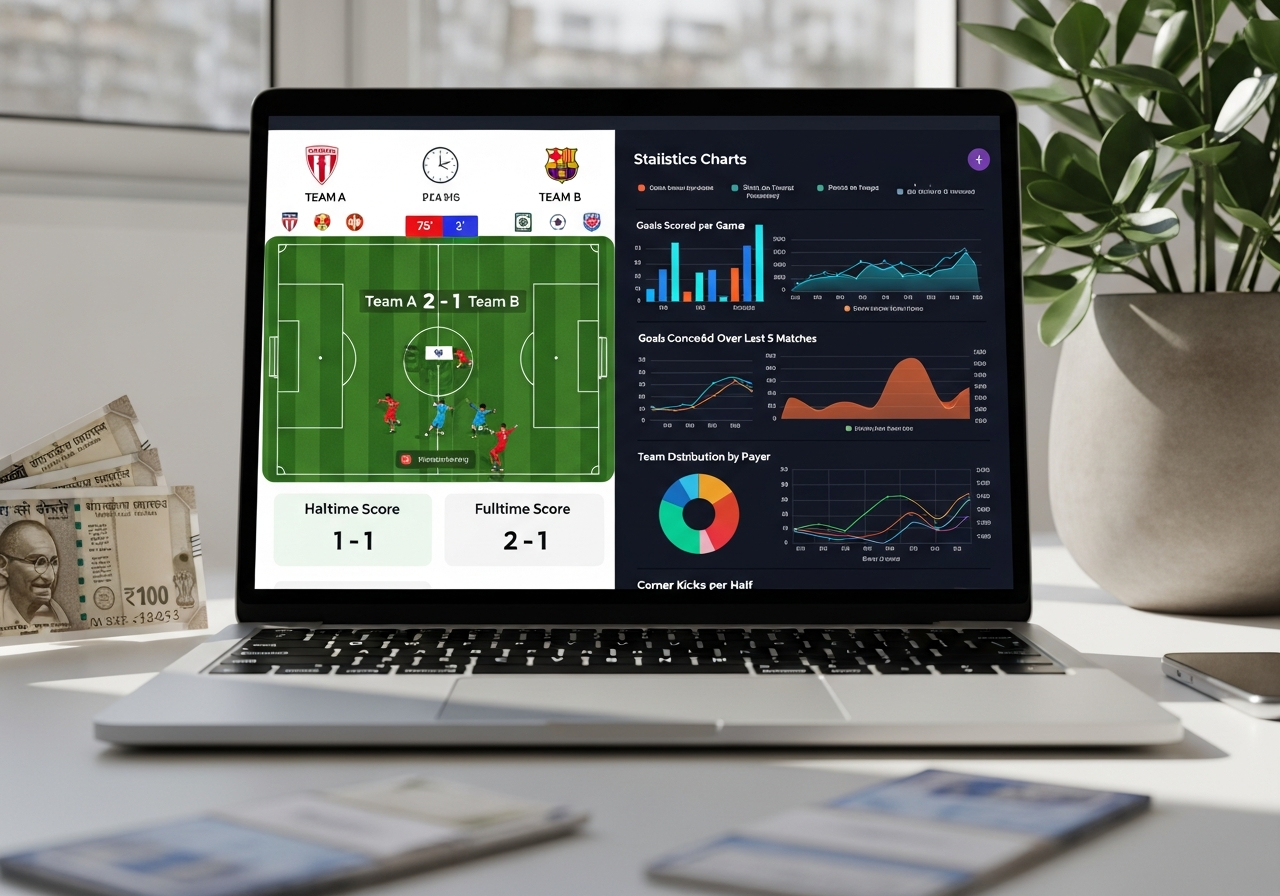
Half-Time/Full-Time (HT/FT) betting has become an increasingly popular choice among Indian football enthusiasts looking for higher odds and more engaging wagering opportunities. Unlike straightforward match-result betting, HT/FT requires you to predict the outcome at both half-time and full-time—a combination that significantly boosts potential payouts but also introduces greater complexity and risk. With the growth of Indian Super League (ISL) football, combined with widespread Premier League fandom and easy access to international sportsbooks, more Indian bettors are discovering HT/FT markets as an exciting alternative to simpler betting options like over/under or standard 1X2 predictions.
This comprehensive guide is tailored specifically for Indian punters. We’ll walk you through HT/FT fundamentals, explain all nine possible outcome combinations with real-world examples, reveal the strategic thinking behind successful HT/FT selection, and most importantly, provide a practical framework for managing risk and bankroll responsibly. Whether you’re progressing from beginner-friendly markets or seeking to refine an advanced betting approach, this article equips you with evidence-based knowledge and actionable workflows to make informed HT/FT decisions.
Understanding Half-Time/Full-Time Betting Basics For Indian Bettors
Half-Time/Full-Time betting is straightforward in concept but demanding in execution. You select what you believe will be the result at half-time (one of three outcomes: Home win, Draw, or Away win) and what the full-time result will be (again, Home win, Draw, or Away win). Both predictions must be correct for your bet to win. Settlement is based on the 90-minute (or 45+45 minutes) official result, and the bet is typically placed before kick-off, though some bookmakers allow halftime adjustments.
For Indian bettors familiar with over/under goals betting or standard match-result (1X2) wagers, HT/FT represents a natural progression toward higher-risk, higher-reward markets. While an over/under bet might ask “Will there be more than 2.5 goals?” and a 1X2 bet asks only “Who wins?”, HT/FT asks a two-part question: “What’s the result at the midpoint, and what’s it at full-time?” This dual requirement means bookmakers price HT/FT outcomes significantly higher than single-outcome markets, reflecting the lower probability of hitting both targets.
Understanding this foundational difference is crucial. When you see an HT/FT odds of 5.00 compared to a standard match-winner bet at 1.80, the elevated odds aren’t arbitrary—they reflect the compounding difficulty of predicting two stages of a match correctly.
How HT/FT Differs From Standard Match Result And Halftime Bets
The distinction between HT/FT and related markets is critical for Indian bettors to grasp. A standard full-time 1X2 bet requires only one correct prediction: the final outcome. If Manchester United are playing Liverpool and you bet on “Home win,” you win if United win at full-time—regardless of what happened at half-time. A pure halftime-only bet, conversely, settles immediately after 45 minutes; it treats the second half as irrelevant.
HT/FT combines both halves into a single conditional prediction. You’re not placing two separate bets; you’re placing one bet with two conditions. This fundamental structure explains why HT/FT odds are substantially longer. If a Home win at full-time is priced at 1.80 (roughly 56% implied probability), and you further condition that bet on the Home team also leading at half-time, the combined probability drops to perhaps 35%, pushing the odds to around 2.85. The more conditions you add, the longer the odds—and the harder it becomes to win.
Key Terms Indian Punters Must Know In HT/FT Markets
Before selecting HT/FT outcomes, familiarize yourself with the vocabulary. 1X2 refers to the three-outcome format: 1 (Home win), X (Draw), 2 (Away win). This applies to both half-time and full-time results, giving you the nine possible combinations. Home and Away denote the two teams; in ISL, this might be Mumbai City FC (home) versus Bangalore FC (away). A favourite is the team with shorter odds (lower probability-implied odds), while an underdog has longer odds. Draw is a tie; this is pivotal in HT/FT because draws at half-time or full-time can happen in football, unlike binary sports.
Full-time result is the match outcome after 90 minutes (plus injury time). Halftime score is the match state after 45 minutes. Understanding implied probability is essential: odds of 2.50 imply roughly a 40% probability (1 ÷ 2.50). Higher HT/FT odds typically imply lower probabilities, which is why they look attractive—but it also means they hit less frequently. Recognizing this trade-off helps you avoid the trap of chasing long shots without discipline.
The Nine Half-Time/Full-Time Outcomes Explained With Examples
Every HT/FT bet resolves into one of nine possible outcomes. The table below maps each combination with realistic scenarios from Premier League and ISL fixtures.
| HT/FT code | Half-time result | Full-time result | Example scenario (Premier League/ISL) | Typical risk level |
|---|---|---|---|---|
| Home/Home | Home leading | Home win | Chelsea 1–0 up at half-time; wins 2–0 full-time | Low to moderate |
| Home/Draw | Home leading | Match ends level | Manchester United 2–1 ahead at half-time; draws 2–2 full-time | High |
| Home/Away | Home leading | Away win | Liverpool 1–0 up at half-time; loses 2–1 full-time | Very high |
| Draw/Home | Level at half-time | Home win | Arsenal 0–0 at half-time; wins 1–0 full-time | Moderate |
| Draw/Draw | Level at half-time | Match ends level | Tottenham 1–1 at half-time; draws 2–2 full-time | Moderate |
| Draw/Away | Level at half-time | Away win | Chelsea 0–0 at half-time; loses 0–1 full-time | Moderate to high |
| Away/Home | Away leading | Home win | Manchester City 0–1 down at half-time; wins 2–1 full-time | High |
| Away/Draw | Away leading | Match ends level | Aston Villa 0–1 behind at half-time; draws 1–1 full-time | High |
| Away/Away | Away leading | Away win | Everton 1–2 down at half-time; loses 1–3 full-time | Low to moderate |
Each outcome tells a narrative. Home/Home suggests a dominant favourite controlling the match from start to finish. Away/Away reflects an underdog getting an early lead and holding it—rarer but possible. Draw combinations often appeal to bettors seeking value, as they offer enhanced odds when a team’s match trajectory shifts mid-game.
How Indian Bettors Commonly Use Each HT/FT Outcome
Most Indian bettors gravitate toward the safer narratives: Home/Home and Away/Away. These combinations align with intuitive match logic—if a team is strong, you expect them to lead early and win convincingly. Bookmakers price these outcomes moderately, balancing reasonable odds (typically 2.50–4.00 for strong favourites) with achievable hit rates.
Draw-involved codes (Home/Draw, Draw/Draw, Draw/Away, Away/Draw) attract bettors seeking enhanced value. A draw at full-time is common in football; when combined with specific half-time outcomes, the odds rise substantially—sometimes to 6.00 or higher—because the narrative becomes less obvious. For example, Draw/Draw might occur if a strong team plays defensively or faces an organized opponent; an ISL match between Mohun Bagan and FC Goa could easily end 1–1 if both teams sit deep.
Swing outcomes (Home/Away and Away/Home) appeal to aggressive bettors who believe a match will swing dramatically. These are volatile and rarely hit, but when they do, payouts are often exceptional (8.00+). Beginners should avoid these unless they have compelling form or injury data supporting a comeback narrative.
Why HT/FT Markets Offer Higher Odds And Risk Than Regular Bets
The core reason HT/FT odds are higher is probability compounding. When two independent events must both occur, their combined probability is the product of the individual probabilities. If a Home win at full-time has a 55% chance and that Home team leading at half-time (given they win) has, say, a 70% chance, the combined HT/FT Home/Home outcome is roughly 0.55 × 0.70 = 38.5%, or odds around 2.60.
Bookmakers further adjust these odds to build in their margin and account for market movement. The result is that HT/FT outcomes—especially those involving draws or comebacks—often look deceptively attractive. A bettor might see 7.00 odds on Draw/Draw and think “it’s a 14% shot,” when in reality, the true probability might be 12%, making the bet a losing proposition over time. This is where discipline and realistic expectation-setting become critical.
Chasing long-shot HT/FT outcomes without structure is one of the fastest ways to deplete a bankroll. The higher variance means that even a well-researched HT/FT selection might lose 70% of the time, whereas a simple match-winner bet might only lose 40% of the time. For Indian bettors managing limited budgets, this variance can be catastrophic if not managed carefully.
Implied Probability And Payout Structures In HT/FT Betting
Implied probability is your gateway to understanding HT/FT value. If odds are 3.50, the implied probability is 1 ÷ 3.50 = 28.6%. Bookmakers typically price odds such that the total implied probability across all nine outcomes sums to slightly more than 100%—the excess (often 3–8%) is their margin or “vig.”
Consider a simple example. Suppose a match has these full-time 1X2 odds: Home 1.80 (56% implied), Draw 3.50 (29%), Away 4.00 (25%). Total = 110%, so the bookie’s margin is 10%. When HT/FT prices are applied, each outcome is adjusted downward (longer odds) to reflect the additional condition. Home/Home might become 3.00 instead of an “intuitive” 2.00, because the bookmaker knows that being ahead at half-time doesn’t guarantee a full-time win—it’s a harder condition to achieve.
This is where comparing HT/FT odds across bookmakers becomes valuable. A Draw/Draw outcome might be priced 5.50 on one site and 5.80 on another. Over time, those small differences compound into meaningful ROI gaps.
Comparing HT/FT With Beginner-Friendly Markets Like Over/Under
Over/under (totals) betting is popular among Indian punters because it’s intuitive: “Will there be more than 2.5 goals?” It’s a binary proposition, often with odds near 1.90 each side, making it less volatile than HT/FT. A bettor needs one correct prediction, not two. Hit rates are often 48–52%, roughly aligned with the near-even odds.
HT/FT is substantially more complex and less forgiving. Your hit rate on a carefully selected HT/FT code might be 35–45%, while over/under might maintain 48–50%. This doesn’t mean HT/FT is bad—the odds compensate for the lower hit rate—but it requires stronger discipline and selective play. You cannot afford to bet HT/FT casually; over/under, in comparison, can be part of a more relaxed betting routine.
For Indian bettors new to football betting, starting with 1X2 or over/under is wise. As you develop pattern recognition and comfort with variance, occasional HT/FT selections can be integrated into a more sophisticated strategy.
Core HT/FT Strategies Popular Among International And Indian Bettors
Successful HT/FT betting blends research, pattern recognition, and disciplined staking. Below is a practical framework used by experienced punters worldwide, adapted for Indian bettors:
- Pre-match research: Examine team form (last 5–10 matches), head-to-head records, and injury/suspension news. Focus on halftime-specific data if available (e.g., “Team X scores 60% of their goals in the first half”).
- Identify league/team patterns: Different leagues and teams have distinct halftime scoring patterns. ISL matches, for instance, often feature cautious first halves, while Premier League fixtures tend to be more open early. Note which teams typically lead at half-time when they eventually win.
- Select HT/FT outcome: Based on research, choose the outcome(s) that tell the strongest narrative. Avoid scatter-gun betting across multiple codes; focus on 1–2 high-conviction plays per matchday.
- Compare odds and assess value: Check odds across available bookmakers. Use implied probability to judge if the odds align with your estimated true probability. Bet only if you perceive an edge (your estimate > bookmaker’s implied probability).
- Set staking plan: Allocate a small unit size (typically 1–2% of your bankroll per bet). Never chase losses with larger stakes.
- Monitor and review: Track results, noting which patterns held and which didn’t. Refine your approach over time.
Backing Odds-On Favourites To Lead At Half-Time And Win
One of the simplest HT/FT strategies is betting on strong favourites to dominate both halves. If Manchester United are at home to a bottom-table side, the Home/Home outcome might be priced 1.60–2.00. The logic is sound: stronger teams often control play early, go ahead, and maintain their advantage.
This strategy works well when backed by strong contextual factors: the favourite is in excellent form, the underdog is depleted by injuries, or the match is at a fortress ground. However, it fails spectacularly when a favourite becomes complacent, faces a well-organized underdog, or an early red card reshapes the narrative. Always verify that the favourite’s recent record actually supports halftime dominance. A team averaging only 0.8 goals in the first half shouldn’t be backed for Home/Home at short odds, regardless of their final ranking.
Spotting Patterns: Using Stats And Form To Select HT/FT Outcomes
Data-driven selection separates disciplined bettors from impulse gamblers. The table below highlights key statistical signals and their implications for HT/FT outcome selection.
| Pattern/stat | What to look for | Suggested HT/FT outcomes | Risk level for Indian bettors |
|---|---|---|---|
| Early-goal tendency (team scores in first 20 min in 4+ of last 5 games) | Indicates aggressive, potent start | Home/Home or Away/Away | Low to moderate |
| Halftime lead conversion rate (team converts 80%+ of halftime leads to wins) | Shows defensive stability in second half | Home/Home or Away/Away | Moderate |
| Comeback frequency (team wins after being behind at half-time in 3+ of last 10 games) | Suggests second-half resilience | Home/Away or Away/Home | High |
| Defensive records (concedes <0.5 goals per half on average) | Indicates tight halftime and full-time defense | Home/Home, Away/Away, or draw combinations | Moderate |
| Draw propensity (draws in 4+ of last 10 games) | Shows team is balanced, less likely to dominate | Draw/Draw or Draw/Home/Away | Moderate to high |
Use these signals in combination, not isolation. A team with early-goal tendency and strong halftime lead conversion is a strong Home/Home candidate. A team with high comeback frequency but poor early-game record might be better suited to Away/Home if they’re the underdog.
Evaluating Team Form, Home Advantage And League Context
Form is critical. A team on a five-match winning streak is fundamentally different from one in a downturn. For HT/FT, examine the most recent 5–10 matches specifically. Did wins come comfortably (dominating first and second half) or narrowly (lucky escapes)? A team that won 3–2, 2–1, 2–1 might not be a Home/Home favourite despite winning; they’re conceding early and struggling defensively.
Home advantage in football is real and varies by league and team. Some ISL sides gain 15–20% in win probability at home; others barely 5%. Research your specific matchup. Manchester United at Old Trafford is a formidable Home/Home candidate; a mid-table ISL side at home to a rival is less certain.
League context matters too. Premier League matches are often frantic and open early; ISL games sometimes feature cautious starts. Champions League ties are strategically complex, with teams often protecting first-leg leads and playing defensively. Tailor your HT/FT selections to the league’s inherent rhythm.
Using Live Information At Halftime Without Confusing HT/FT With Halftime Bets
This is a crucial distinction. A traditional HT/FT bet is placed before kick-off and is locked in. You cannot change it once the match starts. However, many modern sportsbooks allow in-play betting, where you can place bets at halftime based on what has actually occurred (the score, red cards, injuries).
Some platforms blur this distinction by offering “second-half betting” (betting on the outcome from 45 minutes onward) or halftime adjustments to live odds. These are different products from HT/FT. A true HT/FT bet predetermines both conditions; an in-play halftime bet is a new, separate wager on the second half only.
For Indian bettors, clarify with your sportsbook whether you’re placing a pre-match HT/FT (locked, settled at 90 minutes) or an in-play second-half wager (new bet, updated odds). Confusing the two can lead to misunderstanding stake, odds, and settlement—costly errors. Stick to pre-match HT/FT for clarity and discipline.
Advanced HT/FT Variations: Correct Score And Player-Based Parlays
Beyond the standard nine HT/FT outcomes, some bookmakers offer advanced variations:
- HT/FT Correct Score: Predict not just the result (Home/Draw/Away) at both stages but the exact score. For example, betting that a match is 2–1 to the home team at halftime and 3–2 at full-time. Odds are exceptional (20.00+) but hit rates are extremely low.
- HT/FT + Player to Score: Combine an HT/FT outcome with a player prop (e.g., “Home/Home and Virat Singh to score”). This multiplies the conditions and odds, appealing to aggressive bettors seeking maximum payouts.
- Same-Game Parlays with HT/FT: Bundle HT/FT with other markets (over/under, player props, team totals) into a single parlay. A modest three-leg parlay might have combined odds of 15.00+.
These variations are high-risk, speculative tools. They should never form the core of your HT/FT betting; rather, they’re occasional plays when you have unusually strong conviction. For the average Indian bettor, mastering the nine standard outcomes is sufficient.
Same-Game Parlays Involving HT/FT For Indian Bettors
Same-game parlays amplify both potential profit and risk. If you believe a match will be Home/Home and the total goals under 3.5, you might combine both into a parlay with combined odds of 4.50 (vs. 2.80 and 1.85 separately). A ₹1,000 bet becomes ₹4,500—attractive.
However, if either leg loses, the entire parlay fails. Unlike separate bets where one win can offset one loss, a parlay is all-or-nothing. This structure favors bettors with exceptional pattern recognition. For Indian punters without extensive historical data or analytical tools, avoid complex same-game parlays. Stick to simple HT/FT selections.
If you do venture into same-game parlays, keep unit sizes tiny—no more than 0.5–1% of bankroll per parlay. Treat them as entertainment rather than profit engines.
Risk Management And Bankroll Strategy For HT/FT In India
HT/FT’s higher variance demands disciplined bankroll management. Unlike over/under, where you might sustain a 45% hit rate across many bets, HT/FT might require a 35–40% hit rate to remain profitable—and that assumes you’re finding value consistently. Without structure, variance will devastate your account.
Bankroll management principles for HT/FT:
- Unit sizing: Define a unit as 1–2% of your total bankroll. If you have ₹50,000 to risk, one unit is ₹500–₹1,000. Never exceed 3% per bet, even on “sure things” (they rarely exist).
- Win/loss targets: Set a daily or weekly loss limit. If you lose the equivalent of 5 units in a session, stop betting and review. Similarly, if you hit a daily profit target (e.g., +3 units), consider ceasing play to lock in gains.
- Variance awareness: Understand that a 40% hit rate over 50 bets will likely see stretches of 2–5 consecutive losses. This is normal variance, not a sign of strategy failure. Only panic if your hit rate over 100+ bets declines below your realistic expectation.
- Avoid “magic systems”: No betting system guarantees 99% win rates or consistent daily profits. Anyone selling such a system is scamming you. HT/FT is probabilistic; losses are inevitable.
Common HT/FT Mistakes Indian Bettors Should Avoid
- Overrating favourites: A strong favourite on 1X2 at 1.60 becomes Home/Home at 2.30, but that doesn’t mean it hits 70% of the time. Comebacks, tactical adjustments, and fatigue can derail even dominant teams.
- Ignoring draw value: Draws are common in football, yet bettors often underweight draw outcomes in HT/FT. Draw/Draw at 4.50 might be better value than Home/Home at 2.20 if the match profile suggests a balanced game.
- Misreading form and fitness: A team might be on a winning streak but missing key players due to injuries or suspensions. Always cross-check team news before HT/FT selection. An ISL team without its star striker is a fundamentally different proposition.
- Treating HT/FT as a guaranteed system: There is no “select these three outcomes daily and win” formula. Markets are competitive; any edge is small and temporary.
- Over-staking on hunches: Betting larger units on HT/FT based on “feel” rather than data accelerates losses. Stick to your unit plan religiously.
- Chasing losses: A loss on Home/Home is not recovered by aggressively betting Away/Home on the next match. This “revenge betting” is emotional and usually loses more money.
Setting Sensible Limits And Integrating HT/FT With Other Markets
Rather than betting HT/FT exclusively, blend it with more stable markets. A balanced weekly portfolio might look like:
- 50% of bets: Standard 1X2 or over/under (lower variance, lower odds)
- 30% of bets: HT/FT single outcomes (moderate variance, moderate odds)
- 20% of bets: Advanced/parlay (high variance, high odds)
This allocation lets you participate in HT/FT’s upside while hedging against variance with steadier bets. If HT/FT represents more than 40–50% of your play, you’re accepting unnecessary volatility.
Track your results obsessively. Record every bet: outcome, odds, stake, result, and notes on your reasoning. After 50–100 bets, calculate your hit rate and ROI. If hit rate is below your realistic expectation (typically 30–45% depending on selection difficulty), revise your approach—sharpen research, tighten unit sizes, or focus on fewer, higher-conviction plays.
Comparing HT/FT With Other Popular Football Markets For Indian Punters
To situate HT/FT in your broader betting arsenal, here’s how it compares to alternatives:
| Market type | What you predict | Risk level | Complexity | Typical use case for Indian bettors |
|---|---|---|---|---|
| Full-time 1X2 | Single winner or draw | Low | Very low | Beginner entrypoint; primary source of returns |
| Over/Under totals | Total goals exceed/fall short of threshold | Low to moderate | Low | Pairs with 1X2; steady, diversified play |
| Halftime only | Result after 45 minutes | Moderate | Moderate | Speculative second-half insights; less reliable |
| HT/FT | Two-stage outcome | Moderate to high | Moderate to high | Advanced players seeking higher odds; variance-tolerant |
| Double chance | Any outcome except one specific (e.g., “Home or Draw”) | Low | Low | Risk reduction; lower odds, higher hit rates |
| Asian handicap | Levelness adjusted by goals (e.g., Home -1.5) | Moderate | Moderate | Experienced bettors; reduces draw outcomes |
HT/FT sits in the “advanced” tier: more complex than 1X2, higher-risk than over/under, but potentially more rewarding for disciplined punters. It’s not a replacement for 1X2 betting; it’s a supplement for bettors with the analytical skill and bankroll reserves to absorb variance.
When HT/FT Makes Sense Versus Sticking To Simpler Markets
Use HT/FT when you have a specific, data-backed narrative about how a match will unfold. For example, “Team A always scores early and has an 85% halftime lead-to-win conversion rate; Team B is weak defensively. Home/Home is value at 2.50.” This is a HT/FT selection.
Avoid HT/FT when you’re uncertain about match flow, team news is murky, or you’re simply chasing higher odds because they “look good.” Stick to 1X2 or over/under in these cases; a lower return on a high-probability bet beats a high return on a low-probability bet.
For casual Indian bettors, concentrating on 1X2 and over/under is entirely reasonable. HT/FT is an optional advanced tool, not a necessity. Only pursue it if you enjoy the analytical work and can afford the variance.
India-Specific Considerations: Platforms, Regulations And Responsible Play
HT/FT availability varies by sportsbook and jurisdiction. Many major international platforms accessible to Indian bettors offer HT/FT on leading football leagues (Premier League, Champions League, ISL). However, availability can differ by match, league tier, and region. Always confirm HT/FT is offered before planning a bet.
Payment and account requirements in India typically include KYC (Know Your Customer) verification—providing identification, address, and tax information. This is standard and legally required by reputable operators. Use only licensed, compliant platforms to protect your funds and privacy.
How HT/FT Markets Are Offered On Indian-Facing Sportsbooks
On most platforms, HT/FT appears under the match page, often alongside other markets. Navigation typically flows: Football → League → Match → Markets → Half-Time/Full-Time. The nine outcomes are listed with live odds updating in real-time. Some platforms offer a parlay builder where you can combine HT/FT with other outcomes.
Settlement is automatic. Once the match concludes at 90 minutes, HT/FT bets settle immediately based on the official result. If a match is abandoned or postponed, your bet is voided, and stakes are returned. Clarify your sportsbook’s specific settlement rules for unusual scenarios (e.g., if a match restarts the next day).
Responsible Gambling Guidelines For HT/FT Enthusiasts In India
- Set a budget: Allocate a monthly amount you can afford to lose without affecting essential expenses (rent, food, bills). Treat betting as entertainment spending, not income.
- Avoid chasing losses: Losing sessions happen. Resist the urge to bet larger amounts to “recover” quickly. Losses are best accepted and learned from, not chased.
- Use betting limits: Many platforms allow you to set deposit limits, bet limits, or daily loss caps. Use these tools. They’re designed to protect you.
- Never borrow to bet: Do not use credit cards, loans, or borrowed money for HT/FT or any wagering. Bet only with funds you already own.
- Seek support if needed: If betting begins affecting your mental health, relationships, or finances, reach out. Organizations like NCPG (National Council for Problem Gambling) in India provide confidential support.
- Treat betting as entertainment: Enjoy the analytical challenge and the occasional win, but don’t depend on betting for income or relief from financial stress.
Practical HT/FT Betting Workflow For Indian Bettors
Follow this step-by-step process to select and execute HT/FT bets systematically:
- Identify matches: Scan the upcoming fixtures, focusing on leagues and teams you know well. Ignore unfamiliar or low-profile matches where data is sparse.
- Research team form: Review the last 5–10 matches of both teams. Look for halftime scoring patterns, goals conceded early, and consistency.
- Check team news: Verify lineups, injuries, and suspensions. A team missing its top striker or having defensive problems mid-season warrants caution.
- Identify halftime-specific patterns: Does the home team typically dominate early? Does the away team sit deep and frustrate? Use historical halftime data if available.
- Select HT/FT outcome: Based on research, choose 1–2 outcomes representing your strongest conviction. For example, Home/Home if the home side is dominant and the away side is weak.
- Compare odds: Check 2–3 reputable bookmakers for the same outcome. A 2% difference in odds (e.g., 2.50 vs. 2.45) might not seem large, but it compounds over time.
- Calculate unit stake: Apply your unit sizing (1–2% of bankroll per bet). If your bankroll is ₹50,000 and a unit is ₹750, a 1-unit bet on Home/Home at 2.50 is ₹750 to win ₹1,875.
- Place the bet: Input the stake and confirm. Do not adjust or second-guess once submitted.
- Monitor and record: Watch the match if possible, but avoid emotional reaction if your bet appears lost at halftime. Record the outcome and notes (e.g., “Correct selection but unexpected red card in 65th minute changed dynamics”).
- Review: After 20–30 HT/FT bets, analyze your hit rate, ROI, and patterns. Refine your approach.
Example: Building An HT/FT Bet On A High-Profile Match
Imagine a Premier League match: Manchester United (home) vs. Southampton (away). United are in strong form (4 wins in last 5), and Southampton are struggling (1 win in last 7). United’s recent matches show them leading at halftime in 3 of their last 5. Southampton concede early (2+ goals in first half in 3 of last 5 matches).
Research summary: Strong narrative for Home/Home. United are dominant; Southampton are porous early.
Odds check: Home/Home is 2.40 across three bookmakers. A full-time Manchester United win is 1.60. The HT/FT odds (2.40) fairly reflect the added difficulty of predicting both stages.
Your assessment: You believe Manchester United’s true Home/Home probability is 45% (implied 1/2.40 = 42%). You estimate it’s actually ~48%, suggesting value.
Unit size: Your bankroll is ₹40,000; a unit is ₹600. You allocate 1 unit.
Bet placement: ₹600 at 2.40 = ₹1,440 potential return (profit of ₹840).
Execution: You place the bet before kick-off. United score in the 20th minute (1–0), leading at halftime. They add a second in the 75th minute, winning 2–0. Your HT/FT Home/Home bet settles as a winner, and you collect ₹1,440.
Alternative scenario: United are 1–0 up at halftime but Southampton equalize in the 58th minute, and the match finishes 1–1. Your Home/Home bet loses because the full-time result is a draw, not a home win. This is the variance inherent in HT/FT. You accept the loss, record it, and review whether the match context justified your selection.
—
Half-Time/Full-Time betting offers Indian football enthusiasts a compelling path to higher odds and deeper analytical engagement. But it demands respect. The market is not a shortcut to riches; it’s a higher-variance alternative to simpler betting that rewards disciplined, data-driven players and punishes emotional decision-making swiftly. By understanding the nine outcomes, building selections on team patterns and form, managing your bankroll rigorously, and treating betting as entertainment rather than income, you can enjoy HT/FT’s potential while protecting yourself from its volatility. Start small, track your results obsessively, and refine your approach over time. That’s the hallmark of a professional bettor in any market—and HT/FT is no exception.